FGM And Dignity – For Want Of A Chair? My Talk To The World Bank About FGM In The Gambia
Ending FGM in The Gambia (or anywhere else) requires more than law: women also need dignity, autonomy, and economic independence. In this talk to World Bank colleagues I used the practical issue of women farmers having to sit on the ground at meetings to make a broader point about respect and adult status. Three things matter most: committed local advocates, a legal system that truly punishes FGM, and a socio-economic system that lets women live independently. In such a context the chairs became a symbol of recognition, comfort, and dignity for rural women.
You can read this website in the language of your choice via Google Translate.
 I was grateful yesterday for the opportunity to give a Zoom talk, with legal colleagues, to people at the World Bank concerned about #EndFGM. The focus of my own contribution was economics and adult status – I firmly believe women will be less willing to undergo female genital mutilation if and when they have full adult legal and economic status in their own right; but at present that is rarely the case. Women remain in so many ways dependent on the men in their communities, and FGM continues to be essential to securing that dependency.
There are often (if not always?), I suggest, three critical elements required for the eradication of FGM:
*Committed, supported advocates ‘on the ground’ who can talk with direct experience of FGM, as survivors, family members, or (‘even’) past ‘cutters’ who have now realised what FGM really entails; and add to that, where possible, the advice of teachers and clinicians working in the community.
*A legal system which is clear that FGM (and other violence against women and girls) is illegal and will actually be punished.
*And, very importantly, a socio- economic system which enables women to conduct their lives as adults, autonomously, with education, their own (adequate) income and freedom to make their own choices.
As a particular element in one constituency of The Gambia of this third ‘socio-economic’ requirement, plastic chairs became a focus of attention. I explain why below.
Update, 23 November 2024: This is the appeal which we worked on: Chairs for hardworking Gambian women farmers’ meetings. We raised £600! The 50 chairs have now arrived in Lower Fulladu West. So much thanks to all who have donated and / or helped to make this happen.
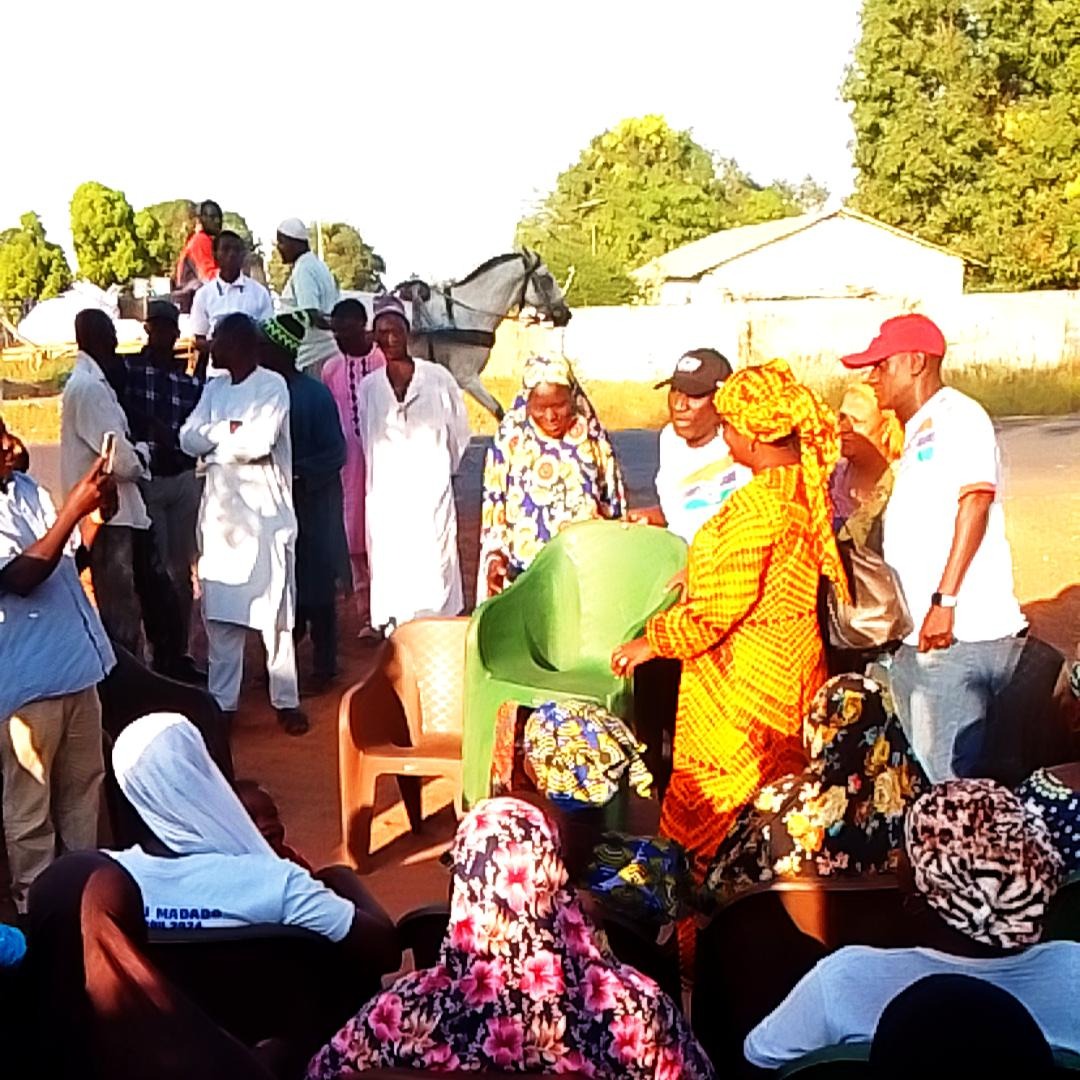
In short, if traditional practices such as FGM are to be eradicated, women on whom this patriarchy incarnate is currently inflicted must be perceived – and perceive themselves – as autonomous adults who make their own personal choices, and who feel absolutely no need to permit damaging assaults upon their bodies, or those of their daughters, to meet the (assumed) traditional and harmful requirements of anyone in their society, male or female, as the basis of acceptance in the community.
FGM will only completely disappear when women are confident that they can conduct their own lives in all respects without ‘needing’ to undergo damaging bodily incursions in the name of ‘virginity’ (‘purity’), bride price or other demeaning socio-economic (and harmful) evaluation of their worth as human beings.
The deeply-set traditional, imposed dependency by women and girls on men is a fundamental bedrock of continued female abuse.
Women’s dignity and autonomy, and the reality of self-reliance, are critical to the abandonment of gendered harmful practices. In this context the challenge of enabling genuine autonomy and adult status for women becomes stark.
One small but immediate way we might address an aspect of this challenge is this:
Let’s make sure these hard-working women, adults bearing a great weight of domestic and economic responsibility, actually have proper seating for their business meetings. These are not children in the playground. Having to sit on the ground is unacceptable.
These women are grown-ups, adults due the simple dignity of comfortable chairs after they have travelled long distances to discuss their business and other community issues.
Setting the scene
As we have previously observed, the Lower Fulladu West constituency of The Gambia, some distance up-river from the capital city of Banjul, is characterised by a number of serious issues, both local and national, which are listed as the Appendix below.
Given these challenges to progress towards a more comfortable life it is unsurprising that rural Gambians especially feel the need for better support – the facilitation of meeting places to discuss problems, better agricultural tools for women growing crops, more health and educational facilities. These are requirements that the local National Assembly Member (MP) the Hon Gibbi Mballow, himself a first generation graduate in pharmacy, seeks to address for his constituents.
Making progress
With these needs in mind, Mr Mballow has recently set up a Community Care Alliance Foundation to support the subsistence farmers, many of them women, in this constituency.
 The Foundation will look to support farmers and other workers in the area, and to facilitate their meeting together to make decisions about how to conduct their businesses.
And this is where the plastic chairs come in.
Adults meeting to discuss important matters around their work and business should not need to sit on the ground; but that is what many women in the area currently have to do when they meet. They have often walked considerable distances to get to the meeting, but there are few chairs to be had on arrival – whilst it is also obviously very difficult to transport one’s own chair when walking miles.
Gibbi Mballow is right to draw attention to this problem. There are basic requirements for any serious discussion, and sitting comfortably to enable direct and constructive communication is one of them.
Similarly, these subsistence farmers have an urgent need for agricultural tools which will enable easier use and more effective nurturing of the soil and its produce. Hopefully that will be the next step in addressing the practicalities around Lower Fulladu West community development. A formal Foundation will provide better opportunities to invest in and modernise local women’s subsistence farming.
Actions speak louder…
We can probably understand why the reality for many of the Hon Gibbi’s constituents is that the daily grind has greater immediate impact than issues around matters such as ending FGM. For some of these constituents FGM represents ‘tradition’ and ‘culture’ which they are reluctant to eschew; indeed, they may see Gibbi Mballow’s efforts to reinforce the illegality of FGM as a direct challenge to a way of life they have known forever. For others, perhaps FGM is simply, and understandably in lives of hard work as subsistence farmers, not their prime focus.
Nonetheless, activists in The Gambia and observers from further afield know that FGM is very harmful. It damages women’s health and puts their babies at risk. It is horribly painful and often inflicts trauma. It reduces the efficacy of women’s every day lives and it reduces the likelihood that they will receive a decent education.
For all these reasons and more the work by Gambian politicians and activists to ensure that FGM continues to be prohibited in law is vital. It must remain a serious crime, despite the claims that it ‘disrespects’ tradition or elders or certain religious beliefs.
But accusations of ‘betrayal’ have been made against those who demand – and have so far sustained – retention of the law against FGM. These brave leaders need to show that they have the interests of their communities and constituents at heart. For Hon Gibbi Mballow one way to demonstrate this genuine concern for his electorate is to secure the purchase of chairs – which will enable the women subsistence farmers to sit comfortably when they arrive for their business meetings, rather than as at present on the ground.
Dignity for adults
‘Plastic chairs’ is not the solution for most of us in the global north to an immediate and critical problem – eradicating FGM and securing the safety of those who advocate for that – but we are forgetting one vital fact: chairs will provide dignity for these women subsistence farmers, and will show them that, Gibbi Mballow, their MP / NAM (National Assembly Member), is doing his very best to support and respect them.
From that modest and deliverable start we can hope the new Community Care Alliance Foundation will flourish, building over the years on the cessation of FGM and the bodily autonomy and better health of the women and girls of Lower Fulladu West, and on the opportunities a formal Foundation will afford for increased investment in decent agricultural tools and better understanding of modern land management.
But first of all: Respect and recognition of these hard-working women as fully independent adults in their own right, due at the very least the courtesy of chairs to sit on for their meetings.
And respect is vital in so many ways.
To re-iterate: three critical elements are required for the eradication of FGM:
*Committed, supported advocates ‘on the ground’ who can talk with direct experience of FGM, as survivors, family members, or (‘even’) past ‘cutters’ who have now realised what FGM really entails; and add to that, where possible, the advice of teachers and clinicians working in the community.
*A legal system which is clear that FGM (and other violence against women and girls) is illegal and will actually be punished.
*And, very importantly, a socio- economic system which enables women to conduct their lives as adults, autonomously, with education, their own (adequate) income and freedom to make their own choices.
At the most fundamental level, to end FGM women must be seen, and see themselves from girlhood, as autonomous adults, free and obliged to no-one; and the same fundamental applies to the hope we all have that communities such as Lower Fulladu West can grow and flourish in that new, enabled environment.
~ ~ ~ ~ ~
APPENDIX: Demographics of The Gambia
Lower Fulladu West is the largest of the five administrative districts of The Gambia, located on both sides of the Gambia River, which is the principal source of water and transport. The main agricultural product are peanuts and rice.
Population
The total population of The Gambia in 2024 is about 2.4 million in a country of some 11,300 km2. Focusing on Lower Fulladu West, the City Population / The Gambia Bureau of Statistics reports the 2013 census as showing the district population as about 40,000 over an area of approximately 370 km2.Health
2024 data gives an infant mortality rate of 29 for every thousand births (in 1950, 148 / thousand) and under-five mortality as 43 per every thousand births (in 1950 410 / thousand). Much has been achieved over the past decades, but more still needs to be done whenever possible.FGM
UNICEF reports that in recent decades rates of FGM in The Gambia have remained largely stable at around 75% of women aged 15-49, with most girls undergoing it before the age of 5. (Type 2 is probably the most common procedure, almost always by a traditional ‘cutter’.) This UNICEF 2013 data also reports that 9% of girls are married (or in a union) before age 15, 30% before age 18, and 19% have given birth by 18. The Gambia Demographic Health Survey suggests that by 2020 the prevalence of FGM had however dropped a little, to 73%.
A 2016 report says that FGM is slightly less prevalent in girls and women in urban areas (51%) than in rural ones (60%). A 2023 UNICEF report states that the percentage of girls and women aged 15 to 49 who know about FGM and think it should continue declines from 50% with a primary education to 39% with a secondary education, and from 52% in the middle wealth quintile to 36% in the richest wealth quintile.Education and literacy
Girls who marry young are significantly less likely to have completed their school education. Nonetheless, education statistics from the Ministry of Basic and Secondary Education (MoBSE), show the primary school completion rate was at 80% in 2023 for boys and 96% for girls. The lower secondary completion rate was at 56% for boys and 75% for girls in 2023 (primary education is free, but in general boys must pay fees for secondary education, whilst girls are now excused.)
UNICEF (2020) gives The Gambia a literacy rate for young adults (15 – 24) of 69% for men and 64% for women.
The World Bank / UNESCO reports that in 2024 net enrolment ratio in primary education (free, but not compulsory) was 94% – 100% for girls, but 87% for boys. It is likely however that girls drop out of school at an earlier age than the boys.
It is also reported that by 2024 in The Gambia 75% of city-dwellers had achieved literacy, but still only 41% of those in rural settings have done so. Likewise, literacy is only half as common among the poorest individuals as among the most wealthy (42% versus 85%).Land and labour
Britannica states that most land in The Gambia is held in common by villagers, which raises issues for women about men who claim ownership. There is a sharp division of labour, with men involved in planting, cultivating, and harvesting cash crops while women cultivate subsistence crops such as cassava (manioc), yams, eggplant, tomatoes, rice, and lentils. The production of peanuts has increased with the wider use of fertilizers and ox-drawn equipment and the introduction of better seeds but electricity is limited to parts of Banjul and a few interior towns, sporadic at best. Most Gambians do not have access to modern infrastructure.
The World Bank event, of which this presentation was a part, was entitled The Gambia, FGM, the Law and Economics. It was hosted by Isabella Micali Drossos and chaired by Lou Marie Clementine Granier, both of the World Bank Female Genital Mutilation/Cutting Legal Working Group. The lawyers who also spoke were my frequent co-worker Lorraine Koonce-Faramande and two Gambian lawyers, Satang Nabaneh and Maria Seine.
~ ~ ~ ~ ~
Read more posts about FGM and the Gambia
~ ~ ~ ~ ~
Books by Hilary Burrage on female genital mutilation
https://orcid.org/0000-0002-6684-2740

A free internet version of the book Female Mutilation is available here. It is hoped that putting these many global narrations onto the internet will enable people to read them in whatever language they choose.
Hilary has published widely and has contributed two chapters to Routledge International Handbooks:
Female Genital Mutilation and Genital Surgeries: Chapter 33,
in Routledge International Handbook of Women’s Sexual and Reproductive Health (2019),
eds Jane M. Ussher, Joan C. Chrisler, Janette Perz
and
FGM Studies: Economics, Public Health, and Societal Well-Being: Chapter 12,
in The Routledge International Handbook on Harmful Cultural Practices (2023),
eds Maria Jaschok, U. H. Ruhina Jesmin, Tobe Levin von Gleichen, Comfort Momoh
~ ~ ~
PLEASE NOTE:
The Inter-African Committee on Traditional Practices Affecting the Health of Women and Children, which has a primary focus on FGM, is clear that in formal discourse any term other than ‘mutilation’ concedes damagingly to the cultural relativists. ‘FGM’ is therefore the term I use here – though the terms employed may of necessity vary in informal discussion with those who by tradition use alternative vocabulary. See the Feminist Statement on the Naming and Abolition of Female Genital Mutilation, The Bamako Declaration: Female Genital Mutilation Terminology and the debate about Anthr/Apologists on this website.
~ ~ ~
This article concerns approaches to the eradication specifically of FGM. I am also categorically opposed to MGM, but that is not the focus of this particular piece, except if in any specifics as discussed above.
Anyone wishing to offer additional comment on more general considerations around male infant and juvenile genital mutilation is asked please to do so via these relevant dedicated threads.
Discussion of the general issues re M/FGM will not be published unless they are posted on these dedicated pages. Thanks.

 Hilary Burrage
Excellent as always, Hilary. Your thinking about the issue consistently illuminates a complex weave of causes and effects, revealing why and how eradication remains such a challenge. Thank you!
Thank you Tobe
Great, Hilary, your dedication to this issue is an inspiration and will result in improved lived experiences for countless women worldwide. Kudos
You’re very kind Francis, thank you.