 You can read this website in the language of your choice via Google Translate.
 You can read this website in the language of your choice via
 .
Hilary is a sociologist and Adjunct Professor at Northwestern University, Chicago (living in London). Much of her work now focuses on the health and safety of children and vulnerable adults, gendered violence, and, particularly, female genital mutilation.
Hilary Burrage is a consultant sociologist and journalist who has extensively researched and written about female genital mutilation (FGM) as a long-time campaigner for its eradication. She is considered an expert on the subject and has authored several highly-regarded books [etc] that address the global practice of FGM and the efforts to end it..Hilary Burrage’s Work and Contributions
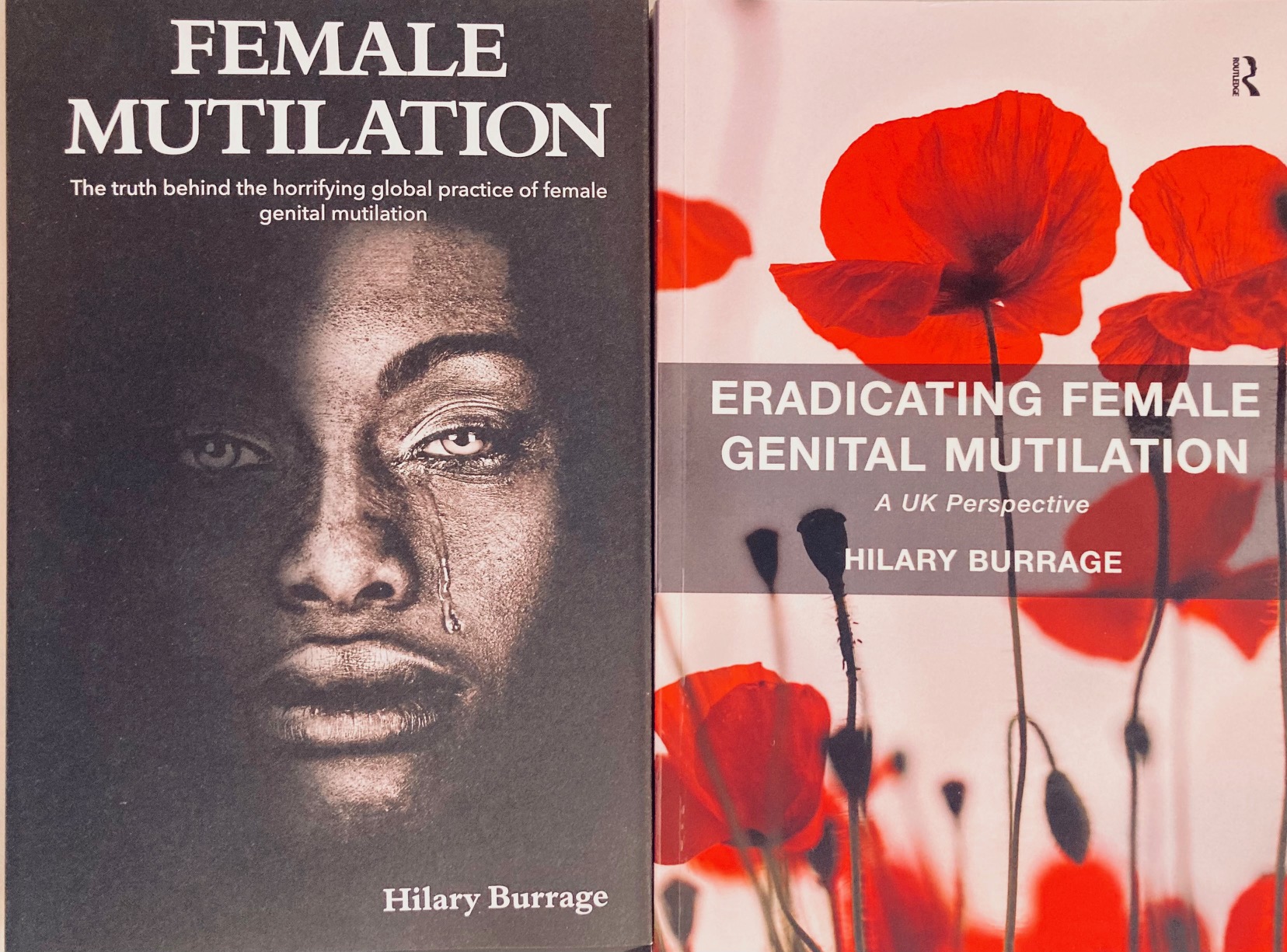
- Authoritative Books: Burrage’s key books on the subject include Eradicating Female Genital Mutilation: A UK Perspective and Female Mutilation: The Truth Behind the Horrifying Global Practice of Female Genital Mutilation. The latter book [also available free online, with a choice of translations: https://femalemutilationworldwide.com] includes more than 70 personal stories from FGM survivors and activists across two dozen countries, offering a powerful look at individual experiences.
- Global Perspective: Her work emphasizes that FGM is not exclusive to Africa, as often mistakenly believed, but is a global issue occurring across parts of the Middle East, Asia (including India, Pakistan, and Indonesia), and also within diaspora communities in Western countries like the US, UK, and Canada, where it is illegal.
- Focus on Eradication and Policy: Burrage advocates for a multi-faceted approach to ending FGM, incorporating community engagement, education, legal enforcement, and an understanding of the underlying economic factors and patriarchal structures that perpetuate the practice. She stresses the importance of men’s influence in the eradication effort.
- Activism and Advocacy: A Fellow of the Royal Society of Arts, she has worked with organisations like The Guardian newspaper on anti-FGM campaigns and participates in international forums and summits to raise awareness and promote action. She also maintains a website (hilaryburrage.com) where she publishes articles and resources.
* Terminology: Burrage and other anti-FGM activists use the term “mutilation,” consistent with the Inter-African Committee on Traditional Practices, to avoid minimizing the harm or ceding to cultural relativism.
In the early 1970s Hilary was the first person in the U.K. to initiate research on women university teachers of natural science. Then as a college teacher she insisted on proper provision (eg creches) for ‘returning’ adults who wanted to study. She also researched teenage pregnancy and later provided consultancy on services such as Sure Start. Her work in the Millennium year saw her make a presentation on arts-based community engagement and regeneration in Liverpool to the Millennium Commissioners. Later, she collaborated with The Guardian on their #EndFGM campaign; and she continues to advise the Global Media Campaign to that end. (One particular focus for Hilary re FGM is economics.) Hilary has also taken forward her enduring concerns around environmental issues and sustainability, including as a member of the DEFRA Science Advisory Council. These are issues not unrelated to the disadvantages faced by many women globally. Over the past decade-plus Hilary has developed her concept of patriarchy incarnate as it impinges on, and shapes, the lives of many ‘ordinary’ women, men and children in a wide range of health / well-being, community and economic contexts.
Further information ‘About Hilary‘ – her books and other publications, and her extended CV, work and experiences (not least navigating decades of personal and social change in the UK!) – can be found via this weblink.
If you choose to read to the end of that weblink account, you will see that LinkedIn really couldn’t tell the whole of my story…..
.
NB Many of my papers, chapters and books have been reviewed and published by major academic publishers. Sometimes however I prefer to share my work (at no further cost to any of us, and NB at no personal financial benefit to myself) more quickly and openly, on this website – where you, the reader, are invited to comment and critique it directly, via the Comment facility at the bottom of every webpost page.

 Hilary Burrage
Comments are closed.