Female Genital Mutilation Surgical Reconstruction: The Italian Perspective…. So Why Is Britain Far Behind Italy And France?
The UK is lagging behind Italy and France in offering FGM reconstructive surgery, even though the technical expertise already exists in the NHS. Reconstruction should be treated as survivor-led repair of injury, not cosmetic surgery; there are growing calls for a proper NHS pathway for women who choose it. Nonetheless, some survivors do not want surgery, and any treatment must involve informed discussion of options and outcomes.
You can read this website in the language of your choice via Google Translate.
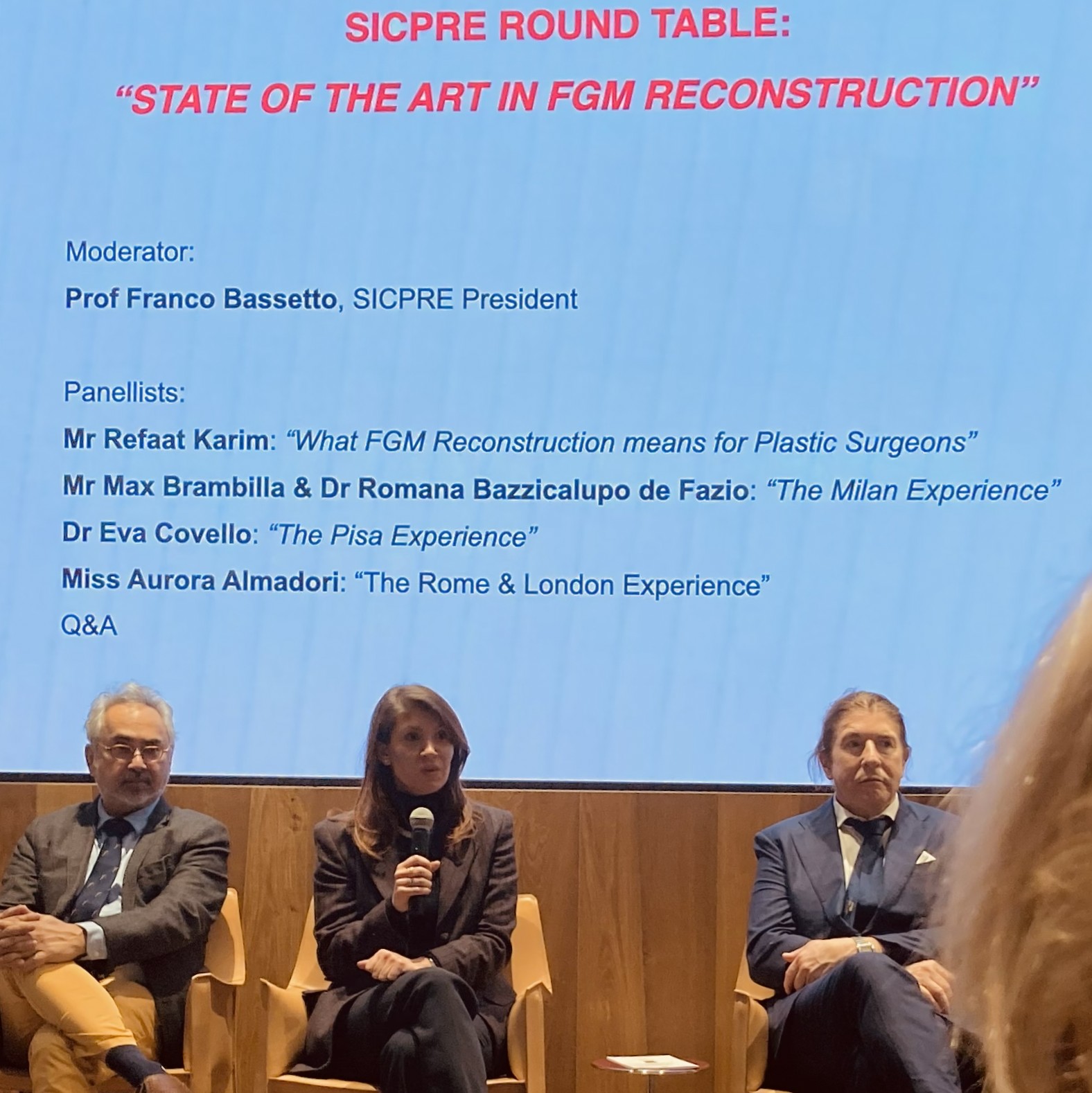 It was a privilege and pleasure to be invited to the Italian Embassy yesterday, 6 February 2026, for an event to mark the Global Day Of Zero Tolerance Against Female Genital Mutilation (FGM).
Distinguished Italian surgeons, both women and men, spoke about their work across Italy and in the UK. They told us how they use their training as plastic surgeons to repair and reconstruct genital damage inflicted on their patients by FGM. But why is Britain so far behind in this essential work?
This event, entitled ‘Investing in Care and Reconstruction‘ was promoted by the Embassy of Italy, London, in conjunction with the Italian Medical Society of Great Britain and SICPRE (Società Italiana di Chirurgia Plastica Ricostruttiva ed Estetica).
The post here explores some of the history and rationales which have informed clitoral reconstruction and similar surgeries in the UK, comparing that background with the story in Italy, France and various other countries.
Decisions and definitions?
 Importantly, those who led this event, the Italian doctors, stressed that only some women seek reconstruction – other prefer to leave things just as they are – and such reconstruction must only be undertaken after careful discussion of options and possible outcomes with the women concerned.
It is also really important, we were told, to understand that, whilst the skills required include ‘cosmetic’ techniques, this is not cosmetic surgery. Rather, it is surgery to repair and reconstruct what has been damaged by a cruel act, illegal now almost everywhere in the world – the result of a crime, not of an elective cosmetic choice.
In many nations but not in the UK…
Our discussions with the Italian surgeons were much appreciated. But on one matter their position remains challenging for those of us in Britain: They are clear that the UK is very much ‘behind’ in the provision of surgical (and other) treatment post-FGM.
Why is clitoral and other genital repair so much more difficult to obtain here, in the UK, than in other parts of Europe? It has been part of the clinical landscape for some years and in a number of countries, including at least on a few occasions in Belgium, Burkina Faso, Canada, Egypt, France, Germany, Italy, the Netherlands, Senegal, Spain, Sudan, Sweden, Switzerland and the USA.
It is significant too that FIGO (the International Federation of Gynecology and Obstetrics) is fully in favour of reconstruction when appropriate:
FIGO strongly recommends that national OBGYN societies ensure the availability of reconstructive procedures when requested by survivors of FGM. These procedures can significantly improve health and wellbeing, addressing complications like chronic pain, sexual dysfunction and psychological trauma. The timing of procedures should be guided by expert knowledge, women’s preferences and local health system capacities, with pre-procedure counselling offering unbiased information on benefits, risks and expected changes. In high-prevalence countries, where reconstructive surgeries remain scarce, FIGO advocates for specialised training for OBGYNs to build professional capacity and ensure the provision of these essential services.
In France, action on this issue was particularly early. Dr Pierre Foldes undertook his first FGM restorative surgery, in Burkina Faso, in 1984, and subsequently set up a clinic in Paris, part of the Women Safe & C hildren organisation, with Frederique Martz, who emphasised from the start the criticality of attending to women’s psychological and social experiences, as well as to their physical presentation. To date Foldes has performed more than 6,000 restorative surgeries and has published assessments of his work (although these have been subject to critique by anthropologists and others because of the complexities of, e.g., interpretation of meanings and data, and / or adequate follow up, and so forth).
The UK position however has been far more cautious than that in France. For years the independent charity FGM National Clinical Group (generously supported and founded in 2007 by the late Ruth Rendell, an acclaimed crime writer who fiercely opposed FGM) was, like the RCOG, unwilling actively to support the idea of reconstruction and in effect disregarded the work of Pierre Foldes, so little progress was made. In 2014 however a cautious repositioning was articulated, as per the Position Statement regarding clitoral reconstruction:
The FGM National Clinical Group (FGM NCG) fully understand that women who have experienced female genital mutilation, genital cutting or “female circumcision” may wish to access surgery to restore or reconstruct the clitoris with the aim of changing the appearance of the circumcised genitalia and possibility of improved sexuality. We are aware of the research undertaken by Foldes (2012). We believe that for some women reconstruction may be beneficial.
The FGM NCG recognize that those women who have undergone clitoral reconstructive surgery are numerically small and that results are inconclusive. The FGM NCG also recognize the need for FGM women to have psychological & emotional support whilst exercising choice and control regarding their sexual health and well being.
Reference: Foldes P, Cuzin B, Andro A. Reconstructive surgery after female genital mutilation: a prospective cohort study. Lancet 2012; 380: 134–41.
This shift has slowly moved the UK debate on.
In 2025 the UK Royal College of Obstetricians and Gynaecologists reviewed its position in the Green-top Guideline No. 53, of July 2015, to support an invitation by the National Institute for Health and Care Research (NIHCR), for applications for funding to undertake a trial of the clinical and cost-effectiveness of reconstruction surgery in FGM/C survivors. This decision arose at least in part from correspondence between the Secretary of State for Health and Social Care Wes Streeting MP, in a letter of March 2025, and Sarah Owens MP, Chair of the Women and Equalities Committee which conducted an enquiry into FGM in the UK.
As the NIHCR noted in their invitation for research proposals:
Surgery has been offered in numerous other countries around Europe since as early as 1998 and elsewhere, but currently reconstructive surgery for FGM is unavailable in the UK due to a lack of randomised controlled trial evidence for its effectiveness. In France alone, over 6,000 women have undergone FGM reconstruction surgery. The lack of provision in the UK has led some British women to travel abroad to have this surgery and it is increasingly being requested.
The NHS does offer genital reconstruction for other purposes, such as gender reassignment/feminising surgery and for vulval cancer survivors which suggests that the technical expertise for such procedures already exists within the NHS.
Past attempts
Several previous attempts to provide restorative surgery in the UK have been made.
In 2016 Tobe Levin and I, with Dr Phoebe Abe-Okwonga and others, set up the registered charity The Clitoris Restoration and Fistula Repair Fund (UK & France) – CRFRF, but it proved impossible to gain financial and public support for this venture, which eventually folded. [See also information about CRFRC by Tobe Levin in the Comment box at the very bottom / end of this post.]
In 2020, the voluntary collective Advocating for Access to Clitoral Reconstruction and Emotional Support Within a Research Framework (ACERS-UK) was set up by the midwife Juliet Albert and colleagues to address this gap in the care management of UK survivors of FGM.
And now, in 2026, there has been a further push for FGM restorative surgery in the UK, via the NHS, led by the Parliamentary Women and Equality Committee enquiry (as above) chaired by Sarah Owens MP. This aligns with current work by Comfort Momoh, a midwife who set up the first FGM services in London (including the first African Well Woman’s Clinic at St Thomas’ Hospital back in 1997), and who also advocates for surgical services for survivor-victims of FGM.
 Given that genital surgery to address ‘cosmetic’ and ‘trans’ concerns is available on the NHS (ie provided via state funding, like most other UK health care) it is difficult to understand why, in a suitably monitored environment, it should not be accessible for women whose genitals (and wider health and well-being) have been damaged by FGM.
Why is such repair, properly managed and assessed, not routinely available, as it is in other parts of Europe and beyond? That is the question posed by the clitoral reconstruction surgeon Aurora Almadori, who led the Italian Embassy #EndFGM event yesterday and who practises her very specific and much-needed skills in a London hospital.
The costs and the benefits
Much has been made in the UK of the economic and resourcing ‘costs’ of clitoral and related surgery, but good practice in other nations can no doubt cast a lot of light on this. Of course there are costs (financial, loss of other opportunities etc) but there are also benefits (less demand for various alternative treatments and services…).
Similar – and of course even more important – considerations apply to the personal benefits of, vs personal costs to, any woman undergoing treatment. But as the recent UK Parliamentary report of the Women and Equalities Committee says, the logical imperative of carefully moderated provision of such surgical services is pressing.
The international conversation and the understanding of the cultural and other complexities are developing rapidly, as is the awareness that FGM need not, at least for some, remain an obstacle to physical, psychological and sexual health. In every case it must, as our Italian hosts insist, without reservation be the informed choice solely of the woman concerned; but for real choices to be made it is imperative that good options be available.
Italy is amongst those leading the way. The UK should follow.
~ ~ ~
For more information about FGM please see: “What we know about female genital mutilation – A summary (2025) of the many and complex aspects”
and the 2025 IHPE Position Statement: female genital mutilation (FGM).
~ ~ ~
Your Comments (see as below) on this topic are welcome.
Please post them in the Reply box which follows at the very end of these announcements…..
~ ~ ~ ~ ~
Books by Hilary Burrage on female genital mutilation
https://orcid.org/0000-0002-6684-2740

A free internet version of the book Female Mutilation is available
here.
[It is hoped that putting all these global Female Mutilation narrations onto the internet will enable readers to consider them via Google Translate in whatever language they choose.]
Hilary has published widely and has also contributed two chapters to Routledge International Handbooks:
Female Genital Mutilation and Genital Surgeries: Chapter 33,
in Routledge International Handbook of Women’s Sexual and Reproductive Health (2019),
eds Jane M. Ussher, Joan C. Chrisler, Janette Perz
and
FGM Studies: Economics, Public Health, and Societal Well-Being: Chapter 12,
in The Routledge International Handbook on Harmful Cultural Practices (2023),
eds Maria Jaschok, U. H. Ruhina Jesmin, Tobe Levin von Gleichen, Comfort Momoh
~ ~ ~
PLEASE NOTE:
The Inter-African Committee on Traditional Practices Affecting the Health of Women and Children, which has a primary focus on FGM, is clear that in formal discourse any term other than ‘mutilation’ concedes damagingly to the cultural relativists. ‘FGM’ is therefore the term I use here – though the terms employed may of necessity vary in informal discussion with those who by tradition use alternative vocabulary. See the Feminist Statement on the Naming and Abolition of Female Genital Mutilation, The Bamako Declaration: Female Genital Mutilation Terminology and the debate about Anthr/Apologists on this website.
~ ~ ~
This article concerns approaches to the eradication specifically of FGM. I am also categorically opposed to MGM, but that is not the focus of this particular piece, except if in any specifics as discussed above.
Anyone wishing to offer additional comment on more general considerations around male infant and juvenile genital mutilation is asked please to do so via these relevant dedicated threads.
Discussion of the general issues re M/FGM will not be published unless they are posted on these dedicated pages. Thanks.

 Hilary Burrage
Tobe Levin (of The Clitoris Restoration and Fistula Repair Fund (UK & France) – CRFRF, as above) writes:
Excellent piece, Hilary, and I feel better informed for having read it.
Only one observation could amplify understanding why the earlier effort was unable to help survivors in the UK who wanted clitoral restoration. Lack of money for the Clitoris Restoration Fund was certainly in play but BREXIT increased the bureaucratic hassles that would have accompanied the solution we once successfully executed: on Sept. 5, 2014, one patient from the UK had a scheduled appointment with Dr. Pierre Foldes in St. Germain-en-Leye. She changed her mind, however, so a second patient, this time a Nigerian from Norway, took her place. Fortunately, the home of a good friend in a neighboring town provided hospitality and recovery was swift. One week later our patient was on her way back to Norway and has reported enjoying a sensitive, healthy, and even good looking organ ever since.