Blade of Tradition in the Name of Religion: A Phenomenological Investigation into Male Circumcision in Iran (Ahmady, 2023)
You can TRANSLATE this website to the language of your choice via the Google weblink.
.
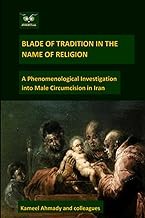 There has long been a debate about whether ‘male circumcision’ – what some of us call ‘male genital mutilation’ (MGM) – can be seen in the same light as female genital mutilation (FGM). My own view is that there are both similarities and, to an extent, differences, but each is done on children who cannot consent, and both can in fact be deeply incapacitating or even lethal (in parts of Africa, many boys die from ritual circumcision every year). Yet still, in some global locations very little is known about the realities of MGM. It is good therefore to report the newly published study by my colleague Kameel Ahmady of male circumcision in Iran. Kameel asked me to write a Foreword to his book. This follows below.
Foreword by Hilary Burrage to Blade of Tradition in the Name of Religion (Ahmady, 2023)
Kameel Ahmady’s book here on male circumcision is timely. Like quite a number of others, he and I have been researching female genital ‘circumcision’ (more accurately ‘mutilation’, FGM) for years; and over time it has become unavoidably apparent to both of us that the documentation of assault on female genitals requires also careful consideration of that on male genitalia.
In this view Ahmady and I are joined by some others, such as the redoubtable Dr Tobe Levin von Gleichen, but not by all who campaign to end FGM. Discrepancies in this position are, I suspect, shaped by direct experience of the harsh inequities in all parts of society of power between women and men, and by perceptions, accurate or not, of the differentials in levels of harm between the practice inflicted on the former as opposed to the latter.
Nonetheless, both female and male ‘circumcision’ can cause deep anticipatory fear in children, and then protracted pain and sometimes life-long trauma; and both can result in permanent harm, or even death. Whatever the traditional rationales, it is, as Ahmady says, difficult to make a cogent case for any such practices in the modern world. Somewhere in the fundamental underlying theme for either there is always power (‘Because I can’), and often plain economics (the relative ‘value’ of people of varying status or standing).
‘Cutting’ – the intentional non-medically-therapeutic physical incursion of blade or other sharp object into a live human body – is a practice reaching back millennia. How far back into history we cannot be sure, but probably even further than the empirical evidence demonstrates. Certainly human sacrifice, the ultimate ‘cut’, originates somewhere in the mists of time.
Whatever, we know there have always been people with enough authority and influence to enable them, whatever their stated intention, to display their power by causing physical (and psychological) harm to other human beings.
Considered rationally, it is astonishing that throughout history people have conceded to more powerful others the right to cause pain and often peril to actual bodies and persona. How does, and did, this gaslighting on such a massive scale ever come about?
If we consider the genital mutilation (so-called ‘cutting’) of either men or women, perhaps there was a time when practical matters offered some justification.
In the case of male circumcision, arising in hot, dry parts of the world, it may have been a response to the risk that sand and other debris would cause painful inflammation and infection, especially if good hygiene provisions such as clean water were in short supply. Removal of the foreskin could in that context be seen as a sensible prophylactic measure. (Maybe there was a parallel sensible rationale for skull caps, in locations where balding men needed protection from the sun?)
Similarly for female genital mutilation (FGM): It seems likely that in ancient Egypt – one of the earliest known locations for female genital incursion – the infibulation (sewing up of labia) of women and female slaves in the top tiers of society preceded other ablation of the genitals. Almost certainly this practice was employed to ‘ensure’ those highly prized wives (and their slaves) were sealed against impregnation or other sexual activity except as required by powerful men. The ownership of the wife and / or mother was thereby secured, and family fortunes were kept intact.
But such justifications or precautions are no longer acceptable, even to many who still live in overtly authoritarian or patriarchal societies. Over centuries understandings of genital cutting have to whatever degree mutated, not always obviously, but somehow continuing. For women family inheritance has been replaced by ideas about ‘purity’ (which apparently applies only to women), and for both women and men original concerns and practicalities have morphed into expressions of solidarity – everyone like us (whether we men be traditional African or contemporary American) is cut; we (women or men in closed communities) are a special group of people.
And so on it goes; traditional practices chameleon-like bending to circumstance, but always finding rationales, or perhaps materialising myths, to ensure that cutting continues; for if we stopped, the painful paradox of what is done would become apparent. Parents would be accountable for harm to their children. Religious leaders and politicians would be held responsible for damage over countless generations.
It is through such a suffocating omerta that Kameel Ahmady in this book finds his way. Iran, the country on which Ahmady focuses as he explores MGM (male circumcision), is probably one of the most opaque countries when it comes to discovering the practice and beliefs which underlie genital mutilation of any sort. The social motivation to avoid the topic at all is substantial, and the sanctions for untoward commentary are sometimes perilous; but it is in such contexts that we can learn the most about what is ‘really’ happening.
In a previous book Kameel gave us substantial accounts of FGM in Iran; and now he adds to that the same personal narratives, contexts, and insights for MGM. The value of first-hand, direct observational experience reportage is unique.
Bringing to public scrutiny (where one can) the genital mutilation of either sex will not of itself achieve eradication of this cruel and unnecessary practice, costly both to some people who experience it and, where their health suffers, to their economies. In many societies tradition, custom and practice easily over-ride more rational and modern human rights perspectives.
At the very least, change implies admission of previous error. Why would traditionalists want to concede that what has occurred with their full endorsement consistently over millennia is ‘wrong’? Why jeopardise their unspoken, assumed authority unless they absolutely must?
But scrutiny leading to eradication is the path Ahmady invites us to follow; and within the narratives he shares here perhaps we will find a chink in the armour of traditional authoritarianism.
I have often referred to FGM as ‘patriarchy incarnate’ – the imposition of (some, powerful) men’s will quite literally onto the bodies and minds of women and girls. It is however becoming better understood that the same process, the same over-arching patriarchal power, can be said to apply to men and boys. Kameel Ahmady’s work gives impetus to this wider view. Genital (or any other sort of imposed, literal) mutilation is a marker of power. Those who impose that marker may well themselves be so-marked, but it is the powerful ones who insist that with no dissent the tradition be continued.
In the modern world, with its global communications, even countries like Iran cannot be entirely closed to contemporary, so-called ‘western’, perspectives such as human rights. Slowly, whatever constraints are imposed, the idea of personal and bodily autonomy – already a concept accepted but observed for particular specifics in the converse by some major religions – is seeping into almost every society the world over. And with that idea comes the logical conclusion that consent is a ‘right’.
The concept of consent, especially in matters of individual bodily autonomy, is an idea which once sown will not easily wither. Likewise, once perceived, the idea is taking root in many locations that children cannot give informed consent to matters they can’t understand.
So perhaps this is a first step towards eradicating painful and dangerous genital mutilations in traditional societies? Genital ‘cutting’ should be consigned as only for consenting adults. From that, as Ahmady’s research indicates, it would not be a step too far for most people to decide that the best kind of cutting in the modern world is none at all.
Hilary Burrage
~ ~ ~ ~ ~
Read more about MGM / Male circumcision.
Your Comments on this topic are welcome.
Please post them in the Reply box which follows these announcements…..
~ ~ ~ ~ ~
Books by Hilary Burrage on female genital mutilation
https://orcid.org/0000-0002-6684-2740

Hilary has published widely and has contributed two chapters to Routledge International Handbooks:
Female Genital Mutilation and Genital Surgeries: Chapter 33,
in Routledge International Handbook of Women’s Sexual and Reproductive Health (2019),
eds Jane M. Ussher, Joan C. Chrisler, Janette Perz
and
FGM Studies: Economics, Public Health, and Societal Well-Being: Chapter 12,
in The Routledge International Handbook on Harmful Cultural Practices (2023),
eds Maria Jaschok, U. H. Ruhina Jesmin, Tobe Levin von Gleichen, Comfort Momoh
~ ~ ~
PLEASE NOTE:
The Inter-African Committee on Traditional Practices Affecting the Health of Women and Children, which has a primary focus on FGM, is clear that in formal discourse any term other than ‘mutilation’ concedes damagingly to the cultural relativists. ‘FGM’ is therefore the term I use here – though the terms employed may of necessity vary in informal discussion with those who by tradition use alternative vocabulary. See the Feminist Statement on the Naming and Abolition of Female Genital Mutilation, The Bamako Declaration: Female Genital Mutilation Terminology and the debate about Anthr/Apologists on this website.
~ ~ ~
This article concerns approaches to the eradication specifically of FGM. I am also categorically opposed to MGM, but that is not the focus of this particular piece, except if in any specifics as discussed above.
Anyone wishing to offer additional comment on more general considerations around male infant and juvenile genital mutilation is asked please to do so via these relevant dedicated threads.
Discussion of the general issues re M/FGM will not be published unless they are posted on these dedicated pages. Thanks.

 Hilary Burrage
Thank you very much, Hilary! I always learn so much from you and I’m so thankful. “Patriarchy” is a 4 letter word (bad word!) in my opinion. Progress is being made in ending FGM but I regularly read articles about people still doing it in secret and in doctors’ offices. We do what we can do – one girl at a time – and we are making great progress in Kenya. UNICEF-Kenya is funding our workshops and community dialogues. Thank God. This gives me more time to fundraise for our scholarship program. Sending big hugs to you and the family!! Much love and respect, Sayydah
You’re very kind Sayydah; thank YOU for all the amazing work that you do!