Medically Unnecessary Genital Cutting And The Rights Of The Child: Moving Toward Consensus
This academic paper, published today, claims there is often a double standard in Western law and ethics around medically unnecessary genital cutting of children, where female genital cutting is treated as a human rights violation while non‑therapeutic male circumcision is often tolerated or endorsed. In principle, all children have an equal right to bodily integrity and future autonomy, so genital cutting without a child’s informed consent is ethically problematic unless it is clearly medically necessary and in the child’s long‑term best interests. A consistent, rights‑based framework is required, applying the same standards regardless of a child’s sex or the cultural or religious rationale given for the procedure.
You can read this website in the language of your choice via Google Translate.
 It has always been my belief that male ‘circumcision’ (also known as Male Genital Mutilation or ‘Cutting’) is, like Female Genital Mutilation, a denial of the fundamental human right to bodily integrity – especially when the person concerned is too young, or otherwise unable freely, to give informed consent to such an act. Today a declaration to that effect, initiated by Brian Earp and edited and agreed jointly by 90 academics including myself, has been published. The text refers expressly to so-called genital ‘surgery’ or ‘modification’ in Western societies, but in large part I’d say it applies also to genital ‘cutting’ in any context.
Below is the abstract for the paper, which is published with open access in The American Journal of Bioethics 19(10):17-28:
- September 2019
- The American Journal of Bioethics 19(10):17-28
- DOI: 10.1080/15265161.2019.1643945
ABSTRACT
We seek to clarify and assess the underlying moral reasons for opposing all medically unnecessary genital cutting of female minors, no matter how severe. We find that within a Western medicolegal framework, these reasons are compelling. However, they do not only apply to female minors, but rather to non-consenting persons of any age irrespective of sex or gender. Keeping our focus exclusively on a Western context for the purposes of this article, we argue as follows: Under most conditions, cutting any person’s genitals without their informed consent is a serious violation of their right to bodily integrity. As such, it is ethically impermissible unless the person is non-autonomous (incapable of consent) and the cutting is medically necessary.
Now read on…
Your Comments on this topic are welcome.
Please post them in the box which follows…..
~ ~ ~ ~ ~
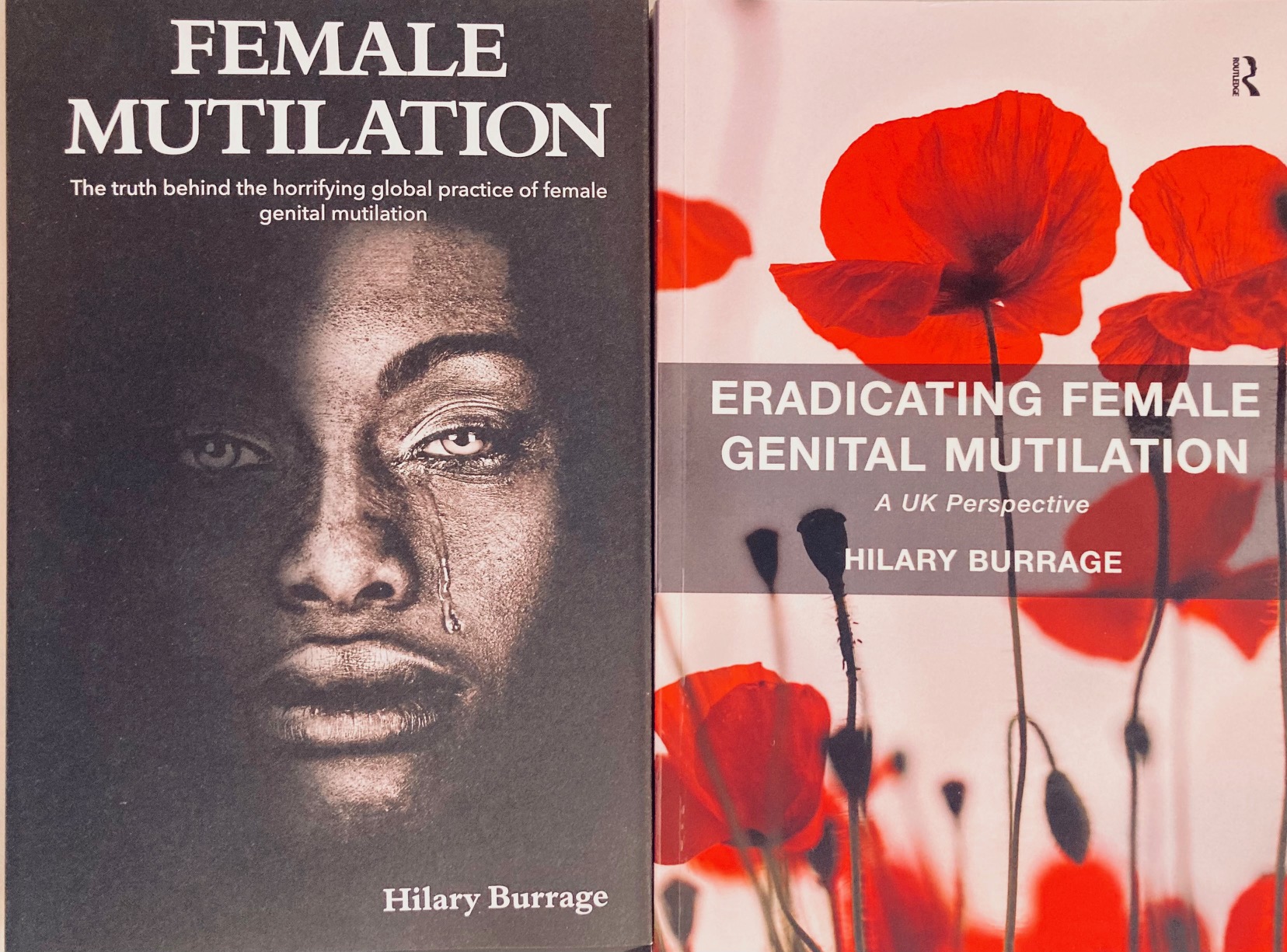
Books by Hilary Burrage on female genital mutilation
https://orcid.org/0000-0002-6684-2740
Eradicating Female Genital Mutilation: A UK Perspective (Hilary Burrage, Ashgate / Routledge 2015).
Full contents and reviews HERE.
FEMALE MUTILATION: The truth behind the horrifying global practice of female genital mutilation (Hilary Burrage, New Holland Publishers 2016).
Full contents and reviews HERE.

FGM: INFORMATION AND ACTION
There is a free FGM hotline for anyone in the UK: 0800 028 3550, or email: fgmhelp@nspcc.org.uk
Details of NHS Specialist Services for FGM here.
More info and posts on FGM here.
Activists, service providers and researchers may like to join the LinkedIn group Female Genital Mutilation (FGM): Information, reports and research, which has several hundred members from around the world.
The (free) #NoFGM Daily News carries reports of all items shared on Twitter that day about FGM – brings many organisations and developments into focus.
Also available to follow at no cost or obligation is the #NoFGM_USA Daily News.
Twitter accounts: @NoFGM_UK @NoFGMBookUK @FemaleMutlnBook @FGMStatement @NoFGM_USA @NoFGM_Kenya @NoFGM_France @GuardianEndFGM [tag for all: #EndFGM] and @StopMGM.
Facebook page: #NoFGM – a crime against humanity