Thank you for visiting. This brief introduction to my website serves as part formal biography, part a personal‑political statement, and also simply as an introduction to my work. Usually I write as a sociologist but occasionally instead as an essayist, so the tone of the posts overall varies according to issues under consideration. I hope you’ll find the ‘conversations’ interesting; please do add comments if you’d like to.
You can read this website in the language of your choice via Google Translate.
 I am an academic researcher / writer and Adjunct Professor at the Buehler Center for Health Policy and Economics, Northwestern University, Chicago (but I live in London). My work now focuses largely on the health and safety of children and vulnerable adults, gendered violence, and, particularly, female genital mutilation. I am a consultant sociologist and journalist who has extensively investigated female genital mutilation (FGM), as a long-time campaigner for its eradication.
I have authored several books and chapters, and many papers and presentations that address amongst other matters the global practice of FGM and efforts to end it. Most of this work is listed below. Over the years I have however also been deeply involved in other public and professional engagements, including environmental, regeneration, arts and diversity concerns, as I explain in what follows:
.
Hilary Burrage’s Work and Contributions
I am an academic writer, consultant sociologist, journalist, and long-time anti-FGM campaigner whose work now mainly focuses on the health, safety, and rights of children and vulnerable adults, gendered violence, and the eradication of female genital mutilation. My writing and advocacy extend across books, chapters, papers, presentations, campaigns, and online publications, emphasising that FGM is a global practice, including Africa, the Middle East, Asia, and diaspora communities in Western countries.
.
An increasingly major theme in my research, particularly since the Millennium, has been FGM eradication through a multi-layered approach involving community engagement, education, law, economic analysis, and attention to patriarchal structures (including the idea of
patriarchy incarnate to describe how gendered power shapes everyday lives and harms). I am an Advisor to the
Global Media Campaign to End FGM (
launched at the United Nations and previously the
Guardian campaign,
where I was a team member) and value collaboration with media and advocacy groups.
.
I choose to publish most of my work openly (with instantly accessible translation to many languages) on this website, at no cost to readers, to invite public comment and critique. I hope this approach will take forward the case for a full academic subject –
FGM Studies – to include
- professional practice aspects – agriculture, education, infrastructure (comms, water etc,) law, medicine and politics/policy,
- the narrative (‘survivor stories’) perspective,
- community / anthropological studies including with activists, and
- rigorous research (and data) across the spectrum of social science disciplines such as economics, enterprise, environmental science, epidemiology, gender studies, public health, social psychology and sociology.
A cogent international discipline, FGM Studies, is in my view critical to any serious intention to finally eradicate FGM.
~ ~ ~
My professional activities, and memberships and engagement over time as an appointed or elected board director of organisations across a range of interests, are listed below….
.
So, in summary:
.
.
Additionally to my appointment to the DEFRA Science Advisory Council, other roles around the Millennium included election as a Director of the British Urban Regeneration Association (BURA). In these roles I focused often on the Knowledge Economy, and I was very active with senior science academics and some politicians in work to promote investment in physics and other big science endeavours in the North West of England, as well as just in the Golden Triangle of Oxford, Cambridge and London.
.
.
.
.
.
.
.
Further information ‘About Hilary’ – my books and other publications, and my extended CV, work and experiences (not least navigating decades of personal and social change in the UK!) – can be found
via this weblink.
.
If you choose to read to the end of the ‘About Hilary’ weblink post, you will however see why a LinkedIn-style CV really couldn’t tell the whole of my story…..
.
* Terminology: Like many other anti-FGM activists, in formal and academic contexts I use the term ‘mutilation’ as consistent with the Inter-African Committee on Traditional Practices, to avoid minimizing the harm or ceding to cultural relativism. The term ‘mutilation’ is a political and ethical choice to emphasise that FGM is always a criminal assault. In conversation with those who have personal experience, direct or via their communities, of this practice, it may nonetheless be more courteous to adopt whatever term they prefer. I am opposed to the non-clinically-essential genital ‘cutting’ of males as well as females.
.
NB Many of my papers, chapters and books have been reviewed and published by major academic publishers. Sometimes however I prefer to share my work (at no further cost to any of us, and NB at no personal financial benefit to myself) more quickly and openly, on this website – where you, the reader, are invited to comment and critique it directly, via the Comment facility at the bottom of every web-post page.
~ ~ ~ ~ ~
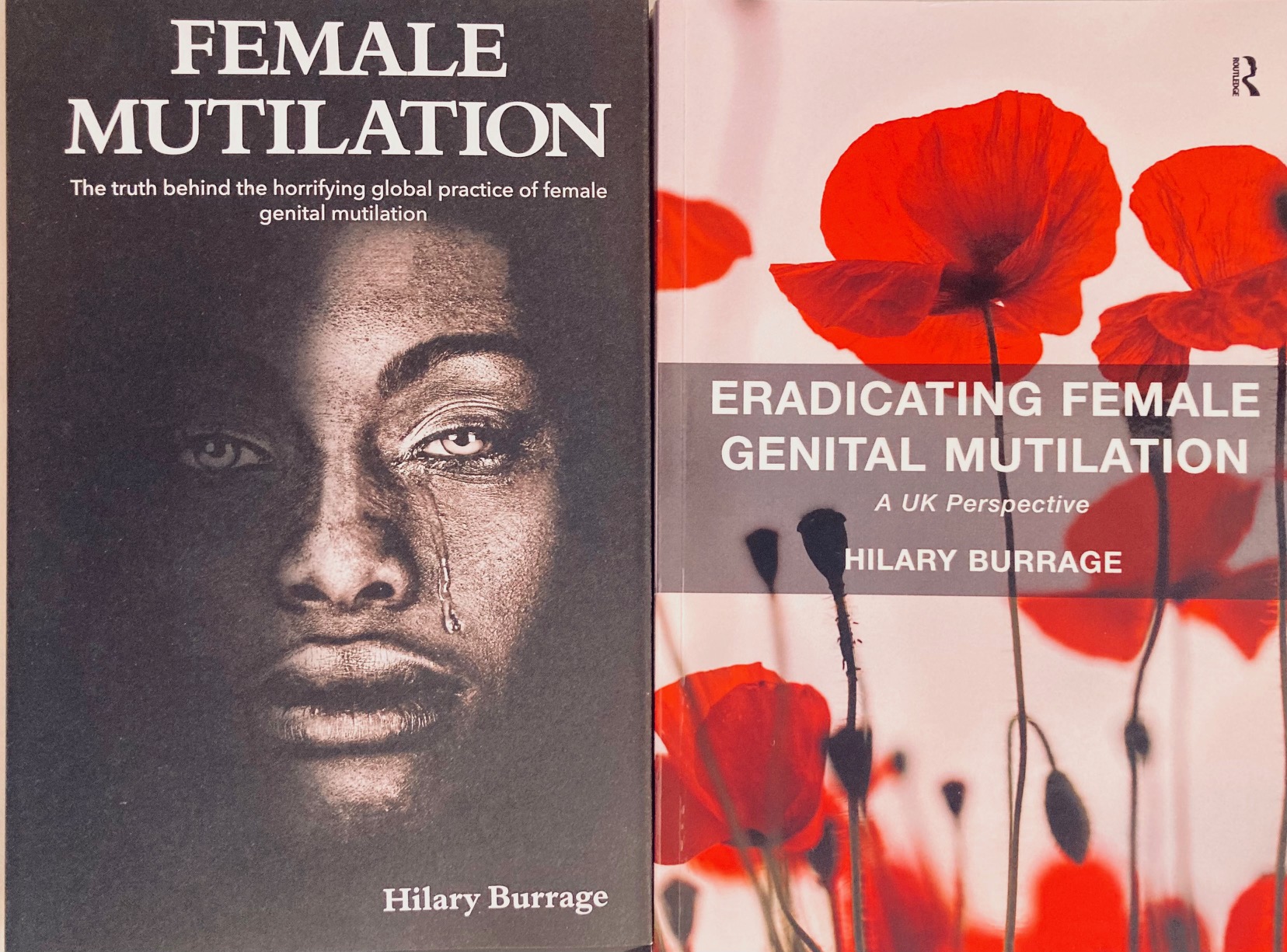
Books by Hilary Burrage on female genital mutilation
https://orcid.org/0000-0002-6684-2740

Eradicating Female Genital Mutilation: A UK Perspective
Ashgate / Routledge (2015)
FEMALE MUTILATION: The truth behind the horrifying global practice of female genital mutilation (Hilary Burrage, New Holland Publishers 2016). (See also free website for entire book: Female Mutilation Worldwide.)
Hilary has published widely and has contributed two chapters to Routledge International Handbooks:

Female Genital Mutilation and Genital Surgeries: Chapter 33,
in Routledge International Handbook of Women’s Sexual and Reproductive Health (2019), eds Jane M. Ussher, Joan C. Chrisler, Janette Perz &
FGM Studies: Economics, Public Health, and Societal Well-Being: Chapter 12,
in The Routledge International Handbook on Harmful Cultural Practices (2023),
eds Maria Jaschok, U. H. Ruhina Jesmin, Tobe Levin von Gleichen, Comfort Momoh
Related
 I am an academic researcher / writer and Adjunct Professor at the Buehler Center for Health Policy and Economics, Northwestern University, Chicago (but I live in London). My work now focuses largely on the health and safety of children and vulnerable adults, gendered violence, and, particularly, female genital mutilation. I am a consultant sociologist and journalist who has extensively investigated female genital mutilation (FGM), as a long-time campaigner for its eradication.

Comments are closed.