Welcome. This website comprises mostly Hilary's sociological papers and articles about patriarchy, (gendered) harmful practices (e.g. female genital mutilation / FGM) and thoughts on science, health, environmental issues, sociological analysis, social policy and good practice.
Our Community Bus Is Our Badge
 Matters budgetary are pretty tight for most social enterprises right now. So is there still a case for capital spending by individual organisations on purchases such as, say, a minibus, even when a taxi account would do?
Rationally, most of us would probably say No. But with their hearts many might even now want to say Yes, there are still good reasons for acquiring and maintaining expensive capital items. But why? What does ownership offer which functional access does not?
FACTASS: The New (1986) Joint Forum of Academic & Teaching Associations In The Social Sciences
 The 1980s posed a considerable challenge for those of us in the social sciences. Just when professional consciousness of the social curriculum was being articulated, the resources and opportunities to develop it were under serious threat, both politically and in terms of resources. Some of us in different social science and social education disciplines therefore conjoined as FACTASS (of which I was founder / Convenor) to address these threats directly. This 1986 Forum announcement was published in Social Science Teacher.
Ageing Is A National Issue
 Perhaps it’s superfluous to observe that ageing is an issue which affects us all quite fundamentally; but you wouldn’t always know that, to judge from the general invisibility of the topic. And that invisibility is a big element of the difficult challenges which policy makers in this field face. Unless we’re very unlucky we shall all experience it, but how many of us want to think about old age? We don’t want to consider the often lonely lives, reduced mobility and other unrelenting afflictions which many older people encounter at some point in their senior years.
Read more…
Is ‘Ruin Porn’ A Good Approach To Regeneration?
 The Centre for Cities 2011 report published in January makes for interesting reading, especially in its focus on the challenges ahead for places like my home town of Liverpool. The debate earlier this year at the launch – which, sadly, I had to miss – will have been compelling. The Centre’s 2011 projections are fairly upbeat for locations such as Bristol and Edinburgh (both, of course, renown for their knowledge-based economies), but the news for cities such as Liverpool (and Birkenhead), Newport and Swansea is measured and dire.
Read more…
David Cameron Stands By Big Society; Others Stand Askance
 The ‘Big Society’ debate continues vigorously (13 February 2011), not least because Prime Minister David Cameron has himself chosen to write about it in The Observer (‘Have no doubt, the big society is on its way‘). But Cameron’s optimism is not shared by everyone, as many respondents to his piece have very clearly demonstrated.
Read more…
Kameel Ahmady is a British-Iranian-anthropologist who has for many years investigated and campaigned against female genital mutilation (FGM), child and other non-consensual marriage (CEFM), the persecution of e.g. gay people (LGBT) and other human rights abuses. In 2019 he was arrested in Iran and held in solitary confinement, accused of activities against the state; and in late 2020 he received a sentence of some ten years imprisonment. Shortly thereafter he escaped from Iran and now lives in Britain. (Details of these events here.)
At the same time as the court in Tehran decided his sentence rumours about sexually inappropriate behaviour by Kameel Ahmady began to circulate on social media. These resulted in his membership of the Iranian Sociological Association being rescinded. Below are two statements (both in approximate English translations) arising from and challenging this accusation and the ISA action arising from it. Read more…
Kameel Ahmady, British-Iranian Anthropologist, Detained In Iran – News Updates (August 2019 to February 2021)
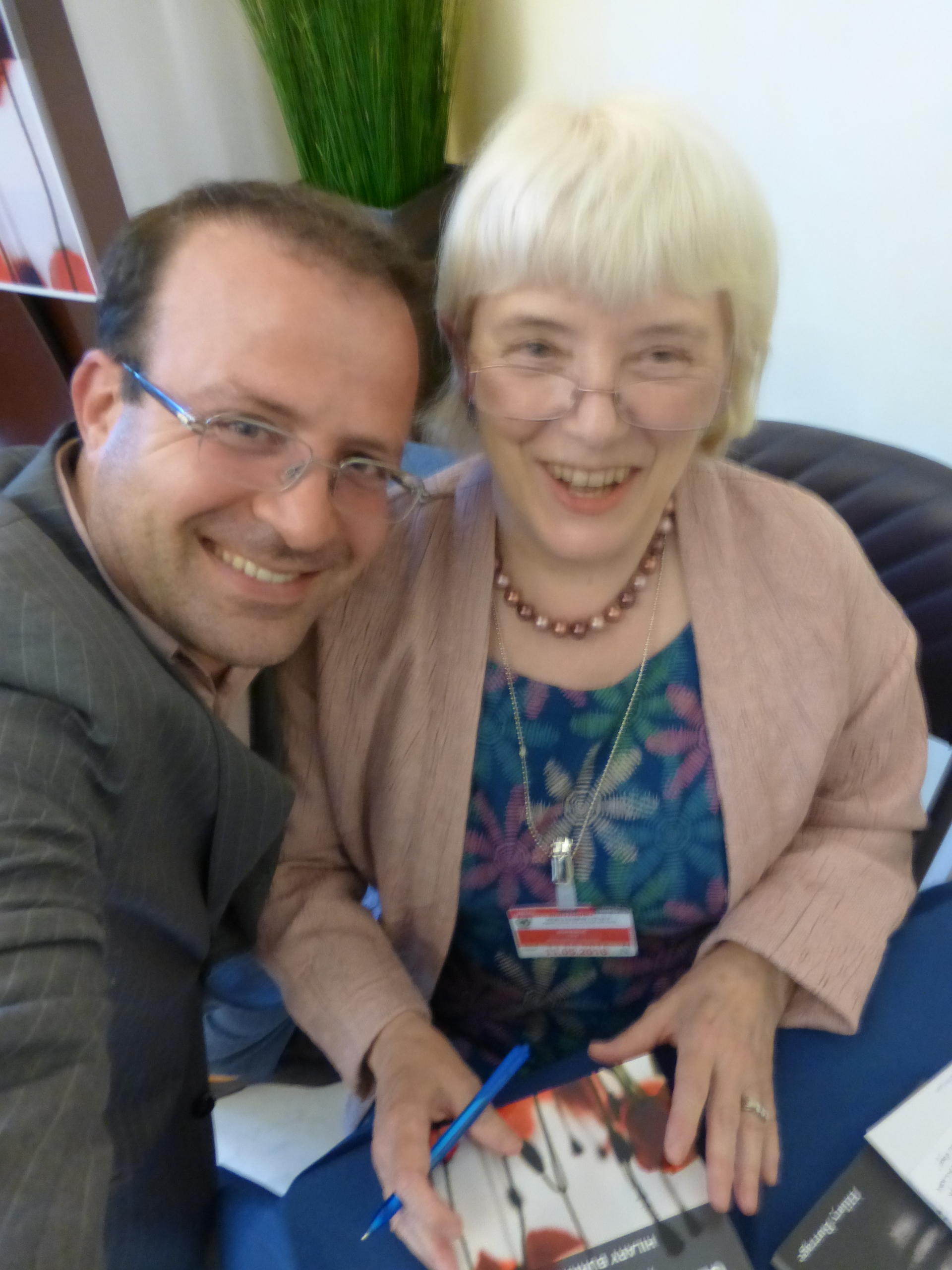 This photograph is of my friend and colleague, the British-Iranian anthropologist Kameel Ahmady, in happier times when he kindly came to support my book launch, and attended the U.N. FGM conference in Geneva in 2016.
But in mid-August 2019 Kameel was detained, and months later bailed, in Iran on vague and political criminal charges relating to ‘national security’. The upshot was a verdict of nine years’ imprisonment and an unthinkably massive fine.
Just after his sentence however Kameel, his wife Shafagh Rahmani and their little son managed in December 2020 / January 2021 to escape to Britain, from where he hopes to continue reporting on female genital mutilation (FGM), child marriage and ‘white marriage’ in the Middle-East
Read more…
Speaking Out On Population
 The Global Population Speak Out is a programme of fundamental importance promoted by the Population Institute in Washington DC. It is, they say … designed to bring new voices into the realm of population activism and public education. By demonstrating that population is an approachable issue, especially in the context of international sustainability initiatives and discussions, the capacity of the human community to achieve long-term sustainable living scenarios with our planet is strengthened.
Big Society Voluntarism Harms The Knowledge Base
 The Big Society so far is no fun at all. It seems to be on-line-style tea and sympathy all round. Almost on a daily basis emails arrive from hard-working, committed contacts, saying their job, role and whatever else is finishing, and they as yet have no clear idea what, if anything, will happen next. And, incredibly short-sighted though this may be, in general it appears no provision is being made by these people’s organisations to retain core knowledge or maintain legacy.
For The Truth About British Society, Follow The (Housing) Money
 The Chartered Institute of Housing, Shelter, Rowan Williams and Boris Johnson all seem to agree; whether social housing can continue meaningfully to exist in the wealthier parts of the UK – mostly London – is doubtful, following the autumn 2010 spending review. Quite rightly, we currently focus on people in social housing, at risk of homelessness and most vulnerable. But the other issue is who owns what housing, where; and why.
Read more…
Talking Is Key To Engagement, But Do We Know How?
 Communicating with each other is held to be really important as an element of community engagement – and of formal stakeholder consultation – so why do most of us in this line of work spend such little time considering it? Do we need to focus more directly on supporting the bond between parents and dependent children, as a critical element of community life?
Read more…
Does Old Age Have To Mean Life On The Sidelines?
 What happens to people as they get older? What should be the starting points for more consideration of this vexed question? With post-war babies now reaching retirement and many of their parents still alive, the numbers of elderly people in the UK is increasing dramatically.
Socio-economic infrastructure nonetheless still often lags behind; whilst never unimportant, advanced old age was until quite recently not a widespread issue. But significantly extended life expectancy is something which will now impinge on most of us, directly.
Read more…
Communities Are Much More Than Localities
 The new agenda in regeneration is emerging, and with it will emerge also a new lexicon. Each of us will have their own priorities for terminological redefinition. Mine is to re-examine the meaning/s of ‘community’. Communities are not just localities; but this is rarely reflected in thinking on regeneration or social policy.
Read more…
Move On If You’re Monied (Or Now Alone)
 The status is still unclear of recent proposals by senior politicians that social housing (‘council housing’ and the like in old parlance) be only for those in greatest financial need. But whether simply political musing, or seriously on the agenda, these propositions are a very bad idea. And so, without very careful preparation, is the idea that you must move on if you are job-seeking or if family changes mean your house has fewer residents and in official terms becomes ‘underoccupied’.
Read more…
Brokering For Adequacy In Austerity
 A bit like redundancy, ‘more for less’ can look OK unless it’s you that’s in the firing line. There’s little most of us as individuals can add to the current commentary about what’s happening to the public sector, beyond hoping (a) that perhaps it won’t be our own name next on the list, and (b) that somehow we’ll cope. But beyond this, someone has to consider how to reduce the likely damage which will ensue.
Read more…
 I gave a keynote this morning (6 July 2010), at the Entrepreneurial Cultures in European Cities Conference, held at the Maritime Museum, National Museums Liverpool. The talk was entitled Culture: Civic Badge or Serious Business? Some thoughts on transaction, creativity and enterprise.My powerpoint presentation, based on a ‘walk down Liverpool’s Smithdown Road’ from downtown to the leafier suburbs, asked how can we shape (relative) gentrification to include the entrepreneurs who bring it about? Where do civic, creative and community interests coincide?
Read more…
Homes, Job Prospects And Horizons: How Far Is ‘Away’?
 Iain Duncan Smith, the work and pensions secretary, proposes to help people move house in order to get work. This is not a new idea; from Norman Tebbit’s ‘on your bike’ onwards it’s been variously proposed by the main political parties that those without employment need encouragement to become domestically mobile. But jobs are not necessarily to be found just around the corner, a mere bikeride – Duncan Smith’s fifteen miles – of where those unemployed currently live.
Read more…
Inaction On Regional Trains Speaks Louder Than Words
 The electrification of railway lines in the NW of England (and elsewhere) has been planned for some while. Money was allocated for this programme by the last government, which recognised the need to modernise regional intercity connections for both economic and environmental reasons. But in the new coalition government’s austerity-focused scheme of things it seems this plan is under threat.Recent personal experience demonstrates why action now on upgrading these lines is essential.
Read more…
A Trial Of Two Localisms
 Has nationally-prescribed double devolution somehow morphed into nationally-prescribed strategic localism? Is either of them actually meaningful without fairly generous national support – whether in resources or in serious leadership?
What Skills Shortage? Sustainability For All…?
 The much-debated ‘skills shortage’ in regeneration was never a clear-cut issue; plenty of volunteers (and some third sector workers) have skills which are consistently underused. And the current economic climate has left even experienced professionally qualified practitioners without a job.
Nonetheless, the skills and knowledge sets for the green economy will surely be different from those required hitherto.
Read more…

 Hilary Burrage