Whose Social Justice? Eradicating Female Genital Mutilation (FGM)
 The eradication of female genital mutilation (FGM) is broadly driven by ‘programmes’ or ‘projects’, some extensive, largely professional outfits – perhaps even global – and others much more modest, maybe just a small group of volunteer campaigners in a remote location. However ambitious (or otherwise) the venture, there is usually an underlying premise that FGM is an obstacle to social justice. It must end, in part, because it damages the prospects for the potential victim of a fair future in which she can flourish.
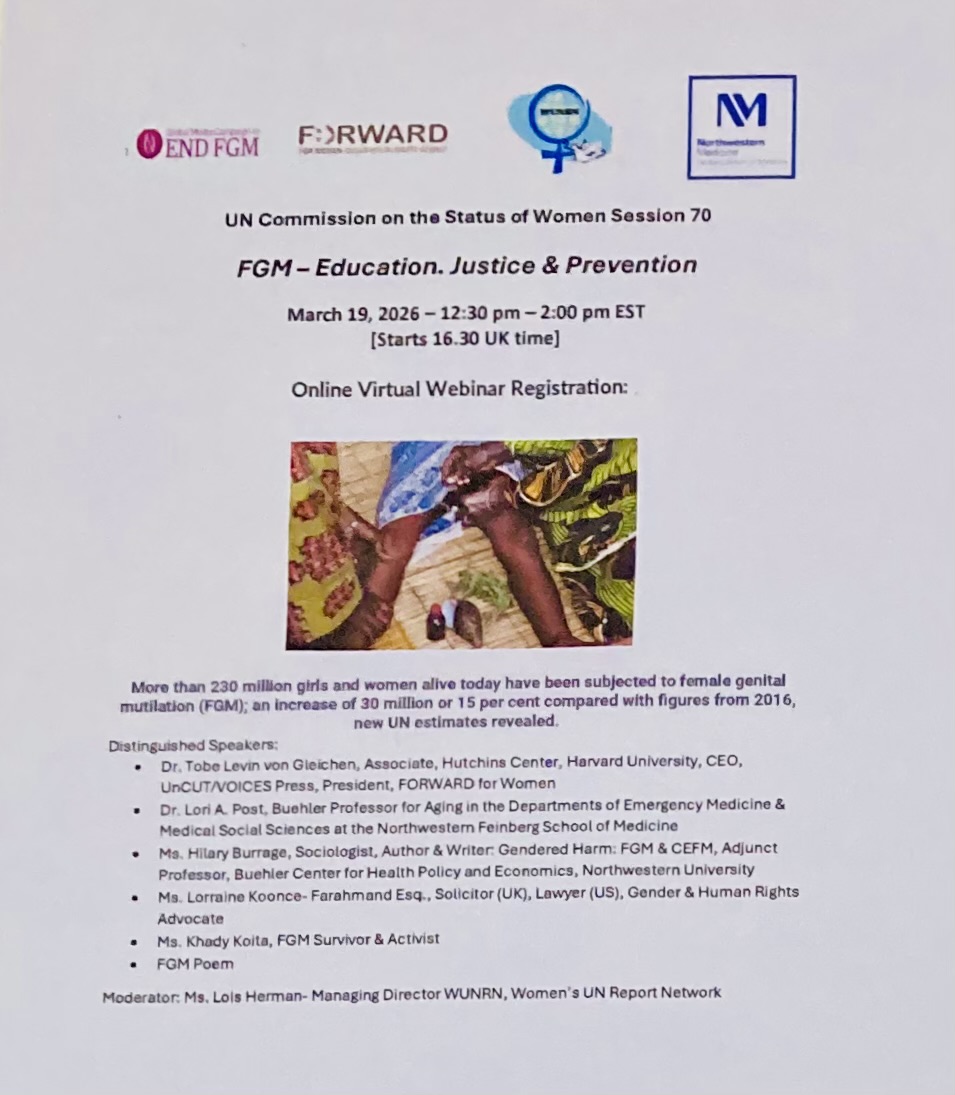
It is this issue which I was invited discuss with colleagues in a Zoom event during the United Nations Commission on the Status of Women (CSW70), on 19 March.
You can read this website in the language of your choice via Google Translate.
For me, an educated Westerner, there is no doubt that FGM must be eradicated as soon as humanly possible; and one reason for this is the logic of social justice. It is only ‘fair’ that all children and adults have an equal opportunity to progress through life the best way they can, fully schooled and unencumbered by needless disadvantage. Avoiding FGM is one way, in communities where it previously occurred, to do so.
But one size does not fit all. Different societies and different cultures have different ways of understanding the world.
Is the apparent imperative, to avoid FGM, always as compelling to people in more traditional communities? Can appeals to justice and fairness fall flat because they comprise a rationale less significant than alternative (potential) insights, e.g., into the immediate connection between FGM and physical well-being, or perilous childbirth? Do appeals to end FGM fall flat when directed at powerful decision-makers for whom ‘women’s problems’ are a relatively inconsequential matter? Rationales for eradicating FGM may vary, as does urgency.
Can we even apply the usually persuasive assumptions about equity, fairness and justice to all efforts to end FGM? Given that total success in ending FGM is still far out of reach, I suspect the answer, the reality in some circumstances, is No, we can’t. Sometimes it seems such justifications are easy to ignore, whether by perpetrators or even policy makers.
We in the ‘West’ (the ‘global North’) tend to think or believe that our way is best. We depend on a global complex web of providers, commodities and information flow never before even dreamed of; and in many ways all these complex phenomena are extraordinary blessings.
Nonetheless our heightened consciousness in the West of technological multitudes has often lessened our awareness of other ways of seeing the world. In knowing so much we have sometimes lost the connections which are critically important to many in the ‘global South’ – the immediacy of local food production, the demands of changing (and yes, now distorted) seasons, the embedded traditions and hierarchies of time-honoured smaller communities.
Contrasting perspectives all have their value, but what makes sense to one set of people may be less persuasive to others. The immediate needs of those in a subsistence agrarian community will not necessarily be the same as those in the downtown sector of a large city. Yet in both locations FGM may for some be a reality which damages health and constrains opportunity.
Defining messages and objectives
We are far from having eradicated FGM, however long and hard many of us have worked to achieve that end; and probably this failure is in part because one size does not fit all. We know that rationales for FGM, the drivers underpinning it, vary significantly, as I discussed in my post Why Does Female Genital Mutilation Occur?
Inevitably, differences of interpretation or opinion may occur when we consider this question. Perspectives will include
- those of the ‘recipient’ of this FGM procedure (often only later, if they were very young when it happened),
- the beliefs, hopes and fears of those who instigated or insisted on the action,
- the motives of the operator/s, the culture and traditions of the host community and, now more often also,
- the legal and other formal frameworks of the location of that community.
And all these perspectives lie similarly alongside the beliefs and frameworks also of any or all who seek by their various interventions to prevent FGM. It is little wonder that in these complex intersections people find plenty on which to disagree. The reasons for eradication are many. As just brief examples:
- Health – innumerable medical studies show FGM damages both women’s physical and mental health, and can also put babies at risk when (and after) they are born. But what if you believe your baby will die if its head touches the mother’s clitoris? or being ‘uncut’ will result in scant prospect of marriage?
- Community – healthy women without FGM can function better in their family and local economies, to everyone’s benefit. But how does this fit with communities stratified over centuries by powerful male leverage and the embedded subservience of women to men (and to senior wives in polygynous families)?
- Consent – the widespread assumption is that FGM is unacceptable because children (and sometimes vulnerable women) cannot give personal, informed consent (c.f. Gillick consent in Western terms) to the ‘procedure’. But in some communities individual consent is not significant. It is the will of the group which determines what must happen and if, for instance, that imperative includes FGM as a marker of membership of the group, FGM will occur.
- Alternative rites of passage – in some communities ceremonies which do not include FGM have been introduced to demark girls’ ‘coming of age’, into adulthood; the traditions of the community are observed without the harm. But not all these communities can legally enforce the ban on FGM…
- Legals – in most countries around the world FGM is now forbidden by law. But what actually comprises FGM may be judged differently in different places: ‘sunna’ – typically Type 1 or 4 FGM (or male circumcision), or ‘Khatna’ in highly educated Bohra groups – may be deemed acceptable (even for a time by some USA paediatricians, as well as in some Muslim communities), but it is in other contexts illegal.
And some of those who have experienced FGM insist they are ‘survivors‘ (i.e. empowered; not all with FGM would agree with that sentiment) whilst others are silently just ‘victims‘ of a crime. This last example, the contrast between a human determination to ‘survive’ inflicted damage, vs the ‘victim’ status which by definition accompanies any personally experienced crime, is telling. Even if not intended, the contrast between individual responses to bodily damaging criminal behaviour is striking.
When we speak of ‘surviving’ we focus on the instinct (of some people) to ‘rise above’ the relevant experience; the focus is on how they seek to move beyond it. (In some communities however the only acceptable response is mandatory celebration of a brutal rite delivered…) But when we talk of being a ‘victim’ we focus on the illegal and harmful act others, the perpetrator and his/her collaborators, imposed on someone else.
Not only do we learn more from these terms about how those who have experienced FGM feel about themselves, but perhaps we also learn something about how they perceive the instigators or perpetrators of the hurt. Most FGM events (and sometimes the ceremonies around it) are initiated by parents or grandparents. How can they – particularly mothers – have wanted this? It must, say some, have been because it was necessary, something for which gratitude – or at least silence – is appropriate.
These contrasting emphases are important, not least because many caring and brave ‘on the ground’ community campaigners have experienced FGM and perceive themselves not as victims but firmly as survivors, demanding the pain be stopped and the future brighter. They offer an excellent example directly to their primary target, girls and women in ‘at risk’ communities, of why FGM must become history.
Different ‘targets’, different messages?
Asking who wants to persuade whom to end FGM remains critical however because the significant resources and political drive required to eradicate FGM only rarely comes directly from women who have actually undergone FGM. Sustained support and direction at a higher level of authority are also required.
A 2018 paper, Human Rights-Based Approaches of Legislation, Education, and Community Empowerment, reminds us that rationales for eradicating FGM differ significantly depending on the stakeholder, ranging from international human rights frameworks to grassroots community initiatives and critical feminist perspectives. The ‘whose rationale?’ question reveals tensions between top-down universalism and bottom-up cultural reform:
Interventions in health care, justice systems, and the social sphere have grown rapidly to address violence against women and girls worldwide. These interventions include large-scale campaigns, education programs, skills building and economic empowerment programming, community mobilization, and participatory group education efforts.
Which, or whether any, of these approaches are usefully meaningful to all activists on the ground may however be debatable. The gap between well-intentioned positioning and real, significant local impact may be substantial.
As Emily Harrison writes, issues around equity, justice and human dignity are complex in a globalised society. Whilst these principles are in one way or another universal, we do not all understand exactly the same things when we use these terms:
…. although human morality is based on some universal ethical principles, such as the pursuit of justice, Equality, and human dignity, there are considerable cultural differences in how these values are expressed and understood. Cultural norms and beliefs, from the focus on individuality vs collectivism to the differing approaches to restorative and retributive justice, greatly influence how people view justice and moral reasoning….. Policymakers and practitioners may work towards promoting justice and fairness in ways that connect with the values and beliefs of varied cultural communities by considering the cultural variables that impact conceptions of justice.
It is probably important always to make the case for FGM eradication simultaneously at various levels – something none of us can do alone. This is surely a teamwork exercise, collaborating thoughtfully between us all for resources, access to health, legal and educational support, working with those who focus on enabling better agrarian environments (or city lives), and, crucially, ensuring political support too: none of this easy, but all of it critical for success.
Each ‘actor’ will have her, or his, own knowledge, contacts and strengths. These absolutely need to be respected, valued and nurtured. Every angle of eradication is vital; but perhaps in some cases trying to build more connection between different parties would help too?
Recontextualising eradication
We have asked before, where does the buck stop in eradicating FGM? We need to know who in a community, region or nation has ultimate responsibility for bringing together the perspectives and efforts of individuals, all with their own drivers for eradication?
Likewise, we can urge that Public Health takes a lead; properly resourced (yes, we wish….), it has enormous potential to promote well-being and prevent harm – which is, after all, also its first objective.
And we can try in every day life to join the dots ourselves, whether environmentally or in other ways. Perhaps we can even seek greater common cause with men? Can more equitable access to basic technologies – for example, access to clean water – enable better family life? Would some activists working together with common cause to end ‘genital cutting’, female or male, and other child harms, be an idea to explore in at least some communities. if / when they are ready for this?
Can we by sharing practical concerns and objectives help to bind together the different vales and perspectives which take forward our work on FGM eradication? I am acutely aware that some of the ideas here are irrelevant (or worse) to the understandings of various people, perpetrators and EndFGM activists alike; but to others perhaps they suggest a few pointers for making progress.
And, finally, a question…
Is it time to deliver serious work via ‘FGM Studies‘? Perhaps, along with current, vitally important appeals to stop, a designated multi-national, interdisciplinary approach hosted by a department of a university or college, might just bring the focus so badly needed?
Would some cross-disciplinary interrogation of all that we know and don’t know about FGM shed more light on how to make progress? It’s a way forward for other difficult subjects, so why not FGM? We need cold analysis as well as heart-felt rejection of this cruel practice.
FGM Studies might bring together independent work on clinical, community, creative, economic, environmental, epidemiological, health, historical, legal, media, narrative, policy, psychological, sociological and other research by experts in their fields. None of this would replace or reduce the essential centrality of activists on the ground, but it might show us better where the ‘gaps’ are. Contested coalescence of differing perspectives on any topic is how progress can be made.
The mix is vital, on one hand we have to persuade communities to stop; and on the other we need to persuade those with power and leverage to resource the stopping. Again, one size does not fit all. Perhaps we must now think more carefully about what beliefs and values must be addressed in different groups and communities – perpetrators, campaigners, policy-makers, funders – and how.
The simple fact is, we globally are nowhere near the United Nations’ Sustainable Development Goal 5.3.2, which aims to eradicate FGM by 2030. Time is running out. Exploring commonly held but differently shaped values, if possible aligning them more closely to support various perspectives in our quest to eradicate FGM, might perhaps be timely at this point?
~ ~ ~
For more information about FGM please see:
“What we know about female genital mutilation – A summary (2025) of the many and complex aspects”
~ ~ ~
Your Comments (see as below) on this topic are welcome.
Please post them in the Reply box which follows at the very end of these announcements…..
~ ~ ~ ~ ~
Books by Hilary Burrage on female genital mutilation
https://orcid.org/0000-0002-6684-2740

A free internet version of the book Female Mutilation is available
here.
[It is hoped that putting all these global Female Mutilation narrations onto the internet will enable readers to consider them via Google Translate in whatever language they choose.]
Hilary has published widely and has also contributed two chapters to Routledge International Handbooks:
Female Genital Mutilation and Genital Surgeries: Chapter 33,
in Routledge International Handbook of Women’s Sexual and Reproductive Health (2019),
eds Jane M. Ussher, Joan C. Chrisler, Janette Perz
and
FGM Studies: Economics, Public Health, and Societal Well-Being: Chapter 12,
in The Routledge International Handbook on Harmful Cultural Practices (2023),
eds Maria Jaschok, U. H. Ruhina Jesmin, Tobe Levin von Gleichen, Comfort Momoh
~ ~ ~
PLEASE NOTE:
The Inter-African Committee on Traditional Practices Affecting the Health of Women and Children, which has a primary focus on FGM, is clear that in formal discourse any term other than ‘mutilation’ concedes damagingly to the cultural relativists. ‘FGM’ is therefore the term I use here – though the terms employed may of necessity vary in informal discussion with those who by tradition use alternative vocabulary. See the Feminist Statement on the Naming and Abolition of Female Genital Mutilation, The Bamako Declaration: Female Genital Mutilation Terminology and the debate about Anthr/Apologists on this website.
~ ~ ~
This article concerns approaches to the eradication specifically of FGM. I am also categorically opposed to MGM, but that is not the focus of this particular piece, except if in any specifics as discussed above.
Anyone wishing to offer additional comment on more general considerations around male infant and juvenile genital mutilation is asked please to do so via these relevant dedicated threads.
Discussion of the general issues re M/FGM will not be published unless they are posted on these dedicated pages. Thanks.

 Hilary Burrage