Gibbi Mballow, Gambian Politician Protecting Women
You can TRANSLATE this website to the language of your choice via the Google weblink.
.
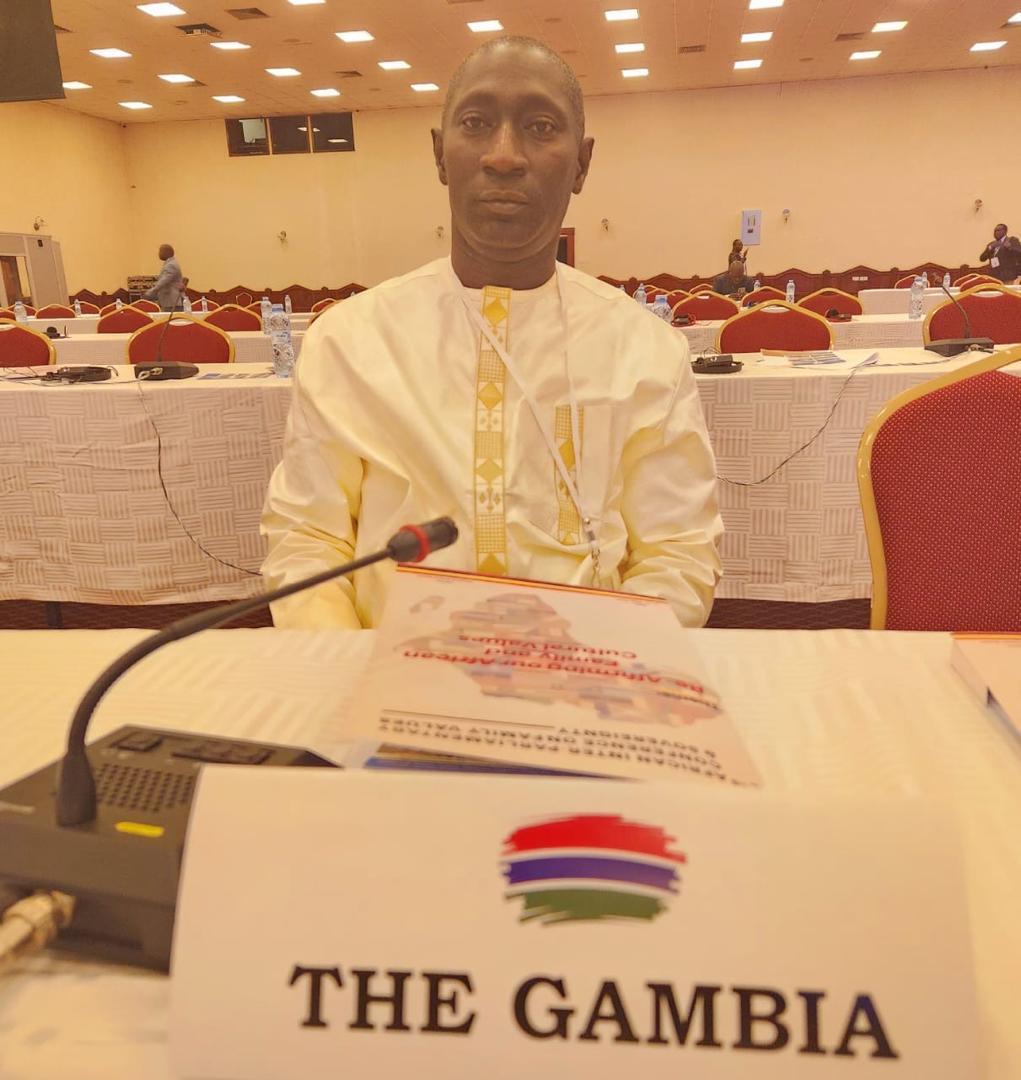 The Hon Gibbi Mballow is a Member of the Gambian National Assembly, the parliament of that country. He represents the Lower Fulladu West Constituency, where he grew up and still lives. He is a member of the National People’s Party. Whilst upholding and respecting his faith as a Muslim, Hon Mballow is aware it cannot be used to justify traditional harmful practices such as female genital mutilation (FGM), a tradition which has caused damage and ill-health to many women and girls. He aims to ensure FGM is abolished in The Gambia forever… and he is speaking out on it.
Nonetheless, the problem about legislating against FGM remains very concerningly. At the end of this post is also the statement Hon Gibbi made on 12 September about the personally perilous position in which he, his family and similarly persuaded colleagues now find themselves.
Gibbi Mballow is deeply familiar with the customs and beliefs of his community, speaking English, Fula, Mandinka and Wolof.
Born in 1979, Hon Mballow was the first generation of his financially modest family to secure a college education, with all the expenses that such education incurs – costs which were challenging for the child of a family engaged only in animal rearing and farming. Nonetheless, Gibbi obtained employment after secondary school as a pharmaceutical dispensing technician at the Royal Victoria Teaching Hospital, and later attended the University of The Gambia, where he gained an HND as a Pharmacy Technician, thereafter becoming a Regional Pharmacy Technician for the Basse Health Directorate.
In 2022 Hon Mballow was elected to The Gambia National Assembly (a position he will hold until 2027), and in 2024 he gained a University of The Gambia Postgraduate Diploma in Public Administration.
Gibbi Mballow is married and has four daughters, so he is very aware of the traditions which relate to the girls and women in his community.
One of these traditions is female genital mutilation (FGM) . The UNFPA estimates that ultimately about three quarters of women and girls experience FGM in The Gambia. Some Muslim people still maintain it should be carried out on young girls (usually babies), even though since 2015 the law in The Gambia prohibits this practice, which is now widely recognised as damaging to girls’ and women’s health and well-being.
Unfortunately, convinced that she was upholding a long-held (but erroneous) belief that Islam requires FGM, Hon Mballow’s mother herself carried out this harmful practice on all four of her granddaughters – without their father’s knowledge or permission. He was horrified when he realised what had happened; and subsequently his mother has also come to see that FGM is never required by Islam, and is a dangerous and injurious, sometimes lethal, ‘procedure’.
It was this family background which persuaded Hon Mballow that he must fight to maintain the legislation against FGM. In late 2023 it was proposed that the National Assembly should rescind this law to permit female ‘cutting’ as a matter of religion, custom and practice. A wide range of Gambian and international voices agree that such a repeal would be a deeply concerning matter, making The Gambia the only country in the world to reverse prohibition.
Gibbi is determined that this will not come about. He has taken the role of lead advocator for rejection of this repeal and is seriously lobbying his parliamentary colleagues to join him in protecting Gambian women and girls from FGM and all other forms of gender harm and inequality. In this work he has been especially supported by many Gambian women who campaigned long and hard to eradicate FGM.
Amongst those who agree with Hon Mballow are 70 Gambian leaders, women and men, who have signed a petition to retain prohibition, and the President of The Gambia, Adama Barrow, who has himself committed to enforcing the law as it stands.
Working innovatively to abolish FGM in The Gambia and to move the agenda forward for equality and other issues, Gibbi Mballow has brought together many different interests, including Imans in his own region of the country. This he sees as an on-going effort, perhaps reflecting that not enough was done to embed the legislation when it was first agreed.
But first the prohibition of FGM must be irrevocably secured, with recognition both that it is not required by Islam, and with the firm consent of an increasing proportion of Gambian citizens – and alongside that determination the rights of women to a life without pain must be established beyond any doubt. These are his words, as reported in The Gambia media outlet The Voice.
We cannot hide behind Islam; we cannot hide behind culture to put pain on our children that is unacceptable. I am a father and I know what my children go through. Are we more religious than the Meccan people? Are we more religious than Senegalese people? We cannot hide behind Islam enough is enough.
Let’s protect our girl child and women these women have suffered in this country, majority of us in parliament are voted by women. This concerns women, if I see men champion this who has never visited women on hospital beds.
When I look at my child at home and the pain she goes through, and I come here to defend the repeal of this law, speaker I’m saying no, and I’m urging all colleagues to do the same.
~ ~ ~ ~ ~
Update, 20 July 2024:
The bill to reject EndFGM legislation in The Gambia fell on Monday 15 July, by a vote of 35 to 17 with two abstentions. Thankfully, FGM continues to be illegal.
This is the Reuters report on the parliamentary debate of 15 July:
Gambia parliament rejects bill to end ban on female genital mutilation
DAKAR, July 15 (Reuters) – Gambia’s parliament on Monday rejected a bill that would have ended a ban on female genital mutilation, after lawmakers voted down all the clauses in the proposed law.
“The ban on FGM is still firmly maintained in the Gambia,” the Ministry of Information said in a statement after the vote. “Government stands firm in its resolve to eliminate this harmful practice.”
The bill to overturn the ban sparked a public debate about female genital mutilation for the first time in the West African nation that divided villages, families and parliament.
The lawmaker who took the proposal to parliament, Almaneh Gibba, said he was upholding cultural and religious prerogatives in the Muslim-majority country where FGM is widespread and deeply rooted. Many Islamic scholars dispute his arguments.
The World Health Organization (WHO) says FGM has no health benefits and can lead to excessive bleeding, shock, psychological problems and even death.
WHO chief Tedros Adhanom Ghebreyesus commended parliament’s decision in a joint statement with high-level United Nations representatives.
“The fragility of progress to end FGM cannot be overstated. Assaults on women’s and girls’ rights in countries around the globe have meant that hard-won gains are in danger of being lost,” the statement said.
The bill had passed a second reading in March with only five out of 53 lawmakers voting against it, raising concerns among rights advocates that Gambia would become the first to reverse a ban on the practice.
But after holding weeks of public hearings, parliament’s health and gender affairs committees presented a joint report on July 8 recommending that Gambia maintain the ban.
Lawmakers adopted the report by a vote of 35 to 17 with two abstentions. Political analysts said lawmakers may have been swayed by testimonies from doctors and survivors about FGM’s harmful consequences.
Parliament voted again on Monday on each of the bill’s clauses ahead of a third and final reading scheduled for July 24.
Around 30 MPs voted against each clause, prompting Parliament Speaker Fabakary Tombong Jatta to stop the bill moving forward to the final reading.
“The (National) Assembly cannot be engaged in such a futile exercise as to allow the bill to proceed to a third reading,” Jatta said after the votes. “The bill is rejected and the legislative process exhausted.”
Gibba said he could not immediately comment because the parliamentary session was ongoing.
Anti-FGM activist Fatou Baldeh, who was cut when she was 8, said she was relieved, but also disappointed the bill had been considered in the first place.
“I am not celebrating for the fact that our women and girls’ lives were put on the line. That made me sad,” Baldeh said.
Gambian legal scholar Satang Nabaneh said the bill’s rejection showed Gambia’s commitment to international and human rights obligations.
“We are hoping that this is a clear call for implementation (of anti-FGM laws),” she added.
Anti-FGM campaigners say the 2015 law banning FGM has been poorly enforced, which the government denies.
The first and only conviction so far, of three women found guilty of cutting eight infant girls, occurred in 2023, prompting Gibba to introduce the repeal bill.
The Hon Gibbi Mballow, one of the lead National Assembly Members who opposed the repeal bill, says
FGM is a cruel and horrible crime which should never be inflicted on any girl or woman.
I am grateful to all the colleagues and communities who supported our efforts to keep the law against FGM in place, but it should never have come to this.
The fight is not over. Still, various people try to intimidate and threaten those of us who want The Gambia to be a nation where all people, women, men and children, are treated with respect for their human rights, health and well-being as we move forward in the 21st century.
Our task now, as activists who will always refute FGM, is to explain to others why this is never, ever acceptable. We must ensure that every child has the opportunities they are due, growing up to become successful and happy adults in a modern nation where no-one is left behind.
That is the challenge for the future which I now set for myself and colleagues, as we also acknowledge our recent essential success in ensuring that the ban on FGM remains. xxxxxxxx
~ ~ ~ ~ ~
And this is the subsequent statement which Hon Gibbi Mballow made, on 12 September 2024:
THREATS OF HATE SPEECH AND HARASSMENT IN THE GAMBIA: A STATEMENT
I need to address a pressing issue that poses a significant threat to the fabric of society in The Gambia: the rising tide of hate speech and its far-reaching consequences. This phenomenon not only endangers the integrity of our democratic processes but also undermines the core values of our community—values such as respect, tolerance, and unity.
Hate speech is a dangerous precursor to societal discord and violence. It undermines the principles of inclusion, diversity and peaceful coexistence that are essential for a cohesive and harmonious society. Its impact is profound, as it erodes social cohesion and obstructs not only sustainable development but also the fulfillment of fundamental human rights. By fostering division, hate speech chips away at the foundation upon which our communities are built.
History teaches us the devastating consequences of unchecked hate speech. Over the past century, we have witnessed how it escalates into the most heinous crimes known to humanity. In the last 75 years alone, hate speech has often been the precursor to atrocity crimes, including genocide. What starts as mere words can morph into actions of unimaginable brutality, as seen in the Rwandan Genocide of 1994, the Bosnian War of the 1990s, and the Cambodian Genocide under the Khmer Rouge. These tragic events serve as stark reminders of how incitement and the normalization of hate speech can lead to widespread violence and the breakdown of entire societies.
In The Gambia, the disturbing signs of this dangerous trend are already visible. Recently, I, along with my family, have become victims of this ugly menace, facing severe harassment and threats by not just the rank-and-file but respectable religious leaders and very prominent members of our society.
Why? Simply because of my stance on the Women (Amendment) Bill 2024 that was debated in the Gambian Assembly, and which resulted, absolutely correctly in my judgement, in a decision by this august body to retain and re-affirm the law of 2015 forbidding female genital mutilation.
However, I am not alone in this experience. Many of my parliamentary colleagues, if they opened up, would share similar stories of harassment, curses, and insults directed at them, as would many of the brave Gambian women who have fought for so long to end female genital mutilation (FGM) in our country.
These experiences are more than just personal grievances—they are indicative of a growing problem that compromises the safety of public officials and undermines our ability to serve our people effectively. When hate speech and intimidation become common, the very fabric of our democratic system is weakened. Public officials cannot carry out their duties with integrity and independence if they are constantly under threat. When National Assembly Members are harassed or intimidated for their decisions, it is not only us who suffer—our constituents lose out as well. In that situation we can no longer freely and fearlessly advocate for them.
Moreover, the wider impact on Gambian society is alarming. Hate speech fosters an environment of fear, distrust, and division. It is not just an online phenomenon. Today, the social media landscape is inundated with insults, harassment, and threats aimed not only at public officials but also at private individuals, civil society, and institutions. This divisive rhetoric often spills over into real-world violence, not least also against the women who advocate for the enduring abolition of FGM. This rhetoric affects the very peace and stability of our communities.
If we allow this dangerous trend to persist, the consequences could be dire. The integrity of our democracy depends on our ability to express diverse views, debate freely, and make decisions without fear for our safety or the safety of our families. Intimidation, harassment, and threats have no place in a democratic society. If we allow them to become normalized, we risk eroding the principles of democracy, justice, and the rule of law.
I aim here not only to highlight my personal experience but to call for a united front in addressing this escalating menace. I urge all of us, politicians, community leaders, everyone in civil society, whether in The Gambia or further afield, to take a position in defence of tolerance and respect for human rights.
We must stand together to combat hate speech in all its forms. It behoves all of us to protect not only our personal safety but the democratic rights of the Gambian people and, indeed, of people everywhere. It is our duty to ensure that our country remains a place where freedom of expression is respected, but where hatred and violence find no sanctuary.
~ ~ ~ ~ ~
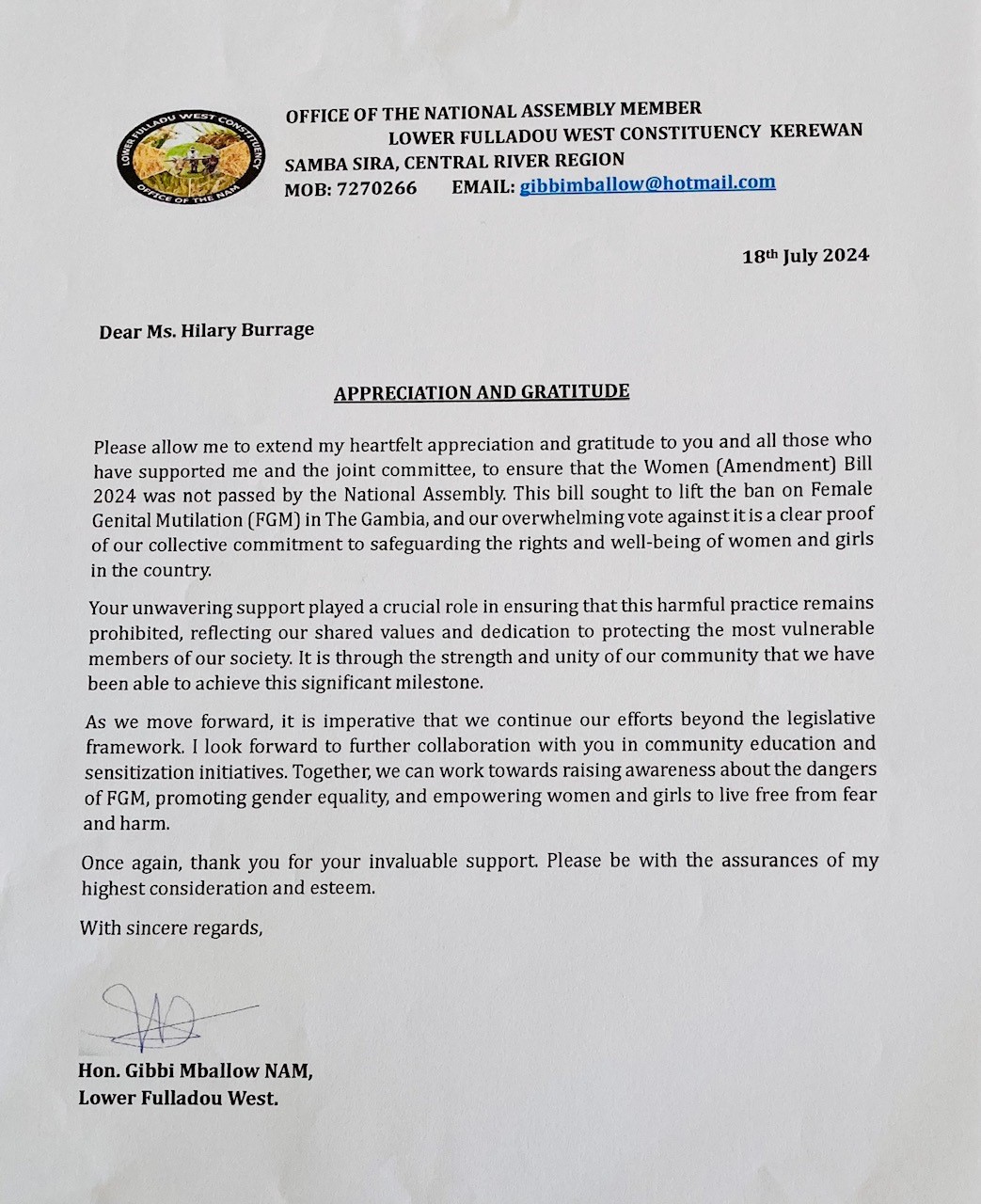
This is the generous thank you from Hon Gibbi to everyone who has supported him. The fight continues:
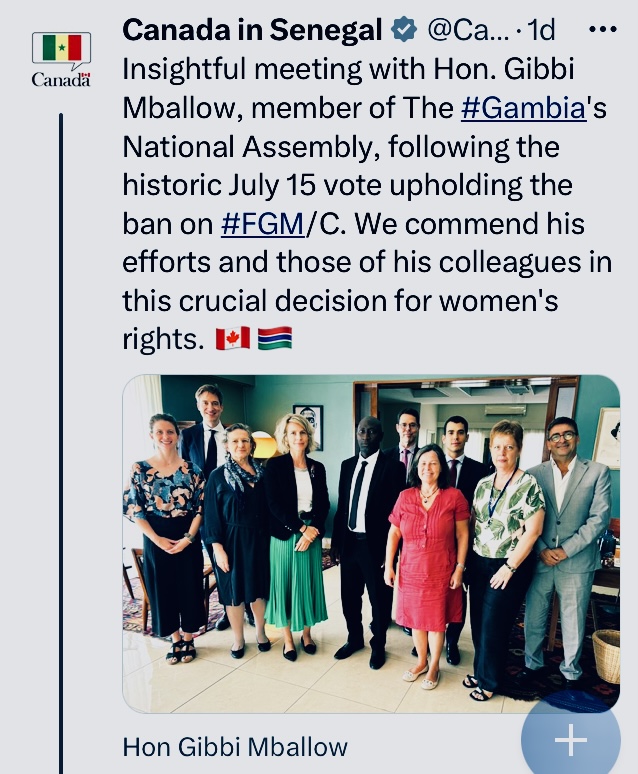
and this is Hon Gibbi himself receiving thanks from the Canadian Embassy (@CanEmbSenegal):
Follow Hon Gibbi Mballow on TwitterX via @GibbiHon9.
~ ~ ~ ~ ~
Read more posts about FGM and The Gambia:
Please DO NOT RESCIND #EndFGM Legislation In The Gambia – An Urgent Petition
Respect The Gambian Women Who Have Fought To Outlaw FGM For Decades
and about Men and FGM:
The ‘Cutting Season’: To End FGM (And Other Violence Against Women) We Need The Men On-Side
White Ribbon Day, And What We Can Learn From Men Who Challenge FGM
Your supportive comments on this activism are welcome.
Please post them in the Reply box which follows these announcements…..
~ ~ ~ ~ ~
Books by Hilary Burrage on female genital mutilation
https://orcid.org/0000-0002-6684-2740

Hilary has published widely and has contributed two chapters to Routledge International Handbooks:
Female Genital Mutilation and Genital Surgeries: Chapter 33,
in Routledge International Handbook of Women’s Sexual and Reproductive Health (2019),
eds Jane M. Ussher, Joan C. Chrisler, Janette Perz
and
FGM Studies: Economics, Public Health, and Societal Well-Being: Chapter 12,
in The Routledge International Handbook on Harmful Cultural Practices (2023),
eds Maria Jaschok, U. H. Ruhina Jesmin, Tobe Levin von Gleichen, Comfort Momoh
~ ~ ~
PLEASE NOTE:
The Inter-African Committee on Traditional Practices Affecting the Health of Women and Children, which has a primary focus on FGM, is clear that in formal discourse any term other than ‘mutilation’ concedes damagingly to the cultural relativists. ‘FGM’ is therefore the term I use here – though the terms employed may of necessity vary in informal discussion with those who by tradition use alternative vocabulary. See the Feminist Statement on the Naming and Abolition of Female Genital Mutilation, The Bamako Declaration: Female Genital Mutilation Terminology and the debate about Anthr/Apologists on this website.
~ ~ ~
This article concerns approaches to the eradication specifically of FGM. I am also categorically opposed to MGM, but that is not the focus of this particular piece, except if in any specifics as discussed above.
Anyone wishing to offer additional comment on more general considerations around male infant and juvenile genital mutilation is asked please to do so via these relevant dedicated threads.
Discussion of the general issues re M/FGM will not be published unless they are posted on these dedicated pages. Thanks.

 Hilary Burrage
Thank you for posting this. It helps to read about the strategies that men are using to work with women to eliminate FGM
GALDEF stands in full solidarity with victims of female genital cutting and intersex genital cutting. FGC/M is an inherently harmful practice that violates the fundamental right to bodily integrity of those who are subjected to it and we fully support the goal of eradicating it and all forms of genital cutting in The Gambia and around the world.
https://dbalablog.blogspot.com/2024/06/because-two-wrongs-dont-make-right-why.html
Thank you David, much appreciated.