Men As Policy-Makers Must Support #EndFGM – Enable Women To Gain Respect As Adults Via Fair Social And Economic Contexts
You can TRANSLATE this website to the language of your choice via the Google weblink.
.
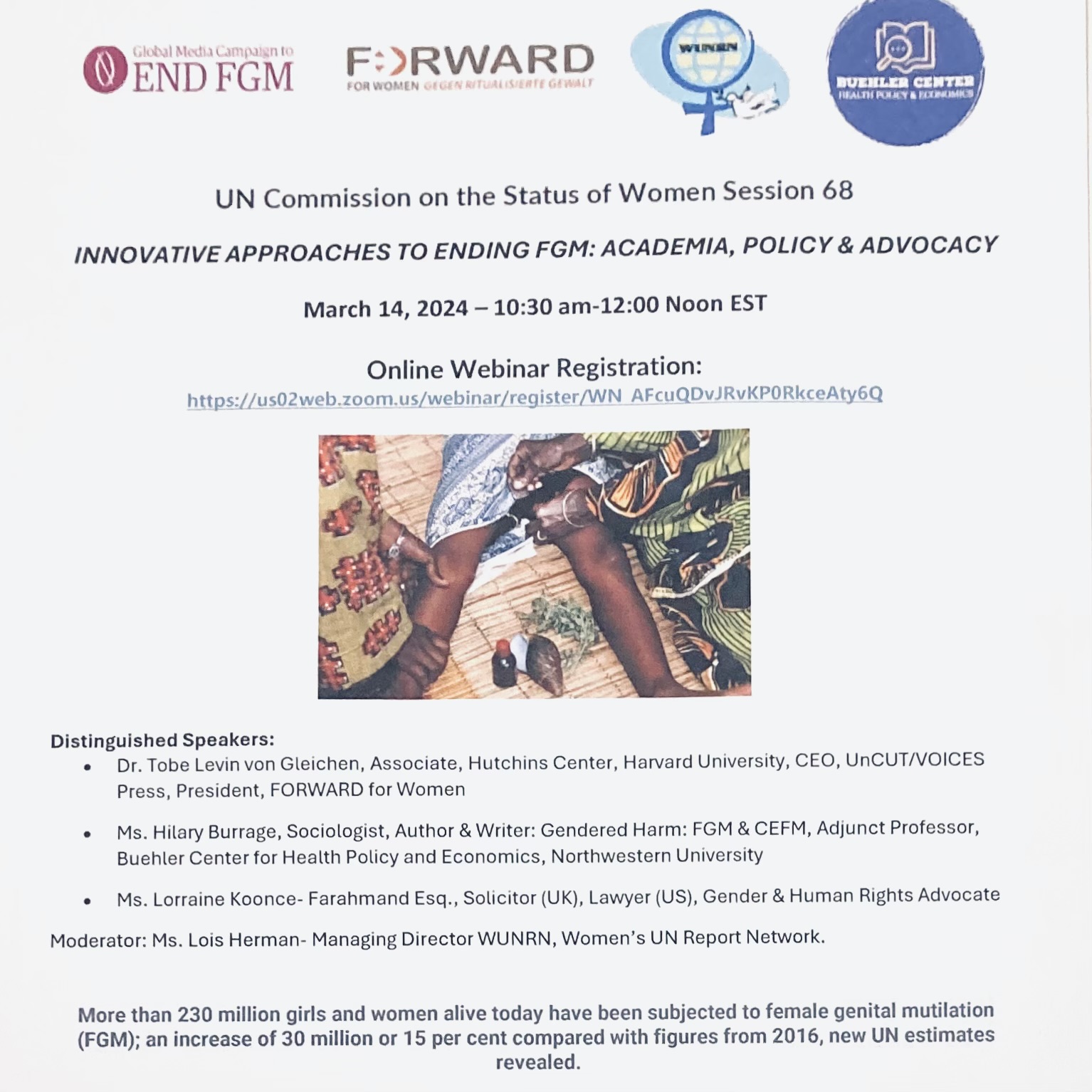
Today I joined my friends and colleagues Dr Tobe Levin and Lorraine Koonce-Farahmand Esq to deliver a session of the Commission on the Status of Women (CSW68), the theme of which this year is “Accelerating the empowerment of all women and girls by addressing poverty and strengthening institutions and financing with a gender perspective”. The title of our presentation, chaired by Ms Lois Herman of WUNRN, was ‘Innovative Approaches to Ending FGM: Academia, Policy and Advocacy’. My topic was Can practical ‘developments’ in socio-economic contexts help end FGM?
My thoughts on this question focused around the criticality of supportive measures by men, comprising the majority of politicians, leaders and policy-makers, in places where female genital mutilation (FGM) still occurs. It is very largely still men who decide how to shape laws, communities and infrastructure; but few consider actively how their decisions can enhance or damage moves to end this cruel and harmful traditional practice.
Nonetheless, there are many more men than those brave few openly declaring their opposition to FGM (examples here), who would like to see it end. I suggest in this post for their consideration some ideas about how that objective might by wider socio-economic developments be pursued.
Efforts to ensure women everywhere are respected as responsible adults, regardless of their FGM ‘status’, might be a powerful force towards eradication. This would require determined focus on enabling women to live their lives autonomously, free to be economically independent, and without the ‘need’ for reliance on husbands and other men.
Like every other aspect of FGM, rationales, deciding factors and circumstances vary hugely over time and between locations, but here are some practical, generally beneficial to everyone, ‘low-tech‘ suggestions about how progress in regard to the status of women might be made, if more males in leadership roles chose to do so. Given that the numbers of women and girls globally with FGM continue to rise – now 230 million – I hope that men will grasp all opportunities to make FGM history, whether by engaging with these provisional ideas, or by developing better ones themselves.
A general note:
I am an academic sociologist, not as such a ‘community activist’, so I mostly look at patterns of behaviour, data and social change, especially around women and FGM. My comments here focus largely on research about FGM in African countries, but probably apply elsewhere too.
This post follows the one I wrote for International Women’s Day (8 March): Eradicating Female Genital Mutilation: Looking At Practical And Low-Tech Ways Forward.
My focus here is practical measures (mostly low- or medium-level technology), usually deliverable by men as policy-makers, which could increase women’s economic standing and their autonomy, and so, by enhancing women’s status and independence, may decrease the perceived ‘need’ for FGM, and their subsequent, often early, marriage as an economic arrangement.
All these considerations are underpinned, as is my work in general, by the concept of patriarchy incarnate and the ways it seeks to control and diminish women.
The topics I will consider here include communications (mobile / cell phones, bicycles, maps), land (ownership, trees and agriculture), food, family size (family planning, stunted children), and water and climate change (burden on women and diminishing resource). Then we will consider the possible impacts of suggested innovations or developments, and how men everywhere can support wider socio-economic moves to help eradicate FGM.
COMMUNICATIONS
> Mobile / cell phones – Yes, mobile phones need solar or other power, and internet connections, but these are basic aspects of infrastructure in most parts of the world. Mobile phone ownership (mostly with internet access) is globally ubiquitous, albeit rather lower for women than men in some parts of the world. In some contexts, e.g. some Maasai communities, men act as gatekeepers for women’s mobile use.
Mobile phones can enable women’s knowledge and standing in many ways. They…
- can increase literacy and deliver education and training remotely (many distance learning packages post-Covid available, and can be adapted as required)
- enable especially women in remote locations to connect beyond the customary boundaries of kinship and locality, opening the possibility of wider experiences
- are vital for contact with emergency, medical and legal services, and can support community health initiatives
- are used by eg the Global Media Campaign to end FGM to promote the eradication of FGM (for full transparency, I am hon. Adviser)
> Bicycles – Rural mobility cuts across most Sustainable Development Goals and bicycles can do much to support this, including in more isolated locations. Bicycles…
- help rural people who need to be able to access schools, health clinics, work related locations etc
- are provided by World Bicycle Relief , so far to 200,000 women with sturdy bicycles in sub-Saharan Africa
- could help ‘barefoot grannies’ (traditional community-engaged matriarchs) who provide health advice, and elsewhere have received training to give technical (solar energy) advice
- transport ‘Male Champions’ in Uganda. who use bikes to combat FGM, teenage pregnancies and child marriages
> Maps –Essential for locating disaster responses and delivering needed services. For example…
- The Humanitarian OpenStreetMap Team is a global community of volunteers, often using mobile phones
- Crowd2Map Tanzania specifically uses mapping to end FGM
LAND
> Ownership – Globally indigenous / local communities formally legally own just c10% of land (perhaps 50% of land globally remains in their hands)
- 10 countries in Africa: 12% women and 31% men report owning land individually; much is legally owned by no-one
- Women continue to be denied land ownership – no legal guardian to protect rights / land rights are only for men / rights are lost on divorce or death / polygamy
- Urban settings can be even more confused; tenured security following migration (or flight) from rural settings is often doubtful – these changes may not be positive for those who must move, perhaps because of war or climate change
- In eg Mali (where almost 90% of girls continue to be cut) paternal grandmothers may demand FGM for their granddaughters to be marriageable or for other customary reasons;
- and currently around 39 percent of adult men (15 years and older) in Mali own at least one parcel of land, in contrast to only 8 percent of women (an improvement on the previous situation), but could legal ownership of land over time confer adult, economically independent, status on women?
> Trees and agriculture – using local knowledge and sharing new knowledge and resources
- 2019 UN Women reported that women are not ‘less efficient’ farmers; they have less time and fewer resources (eg family labour, high-yield crops, pesticides, and fertilizer) and equipment etc
- Projects such as She Grows in Mali supported 1,000 women to grow trees, food and income.
- The Great Green Wall (8,000 km trees, vegetation, fertile land in the Sahel) is increasing biodiversity, crops, jobs
- How can women be assured of the benefits of these developments, giving them independence as adults, without the ‘need’ for FGM?
FOOD – we can ‘feed the world’ with no-one going hungry (which is also relevant to our next topic)
- Consumption is ‘unbalanced’, the global north’s consumption of water- and land-intensive food is high and the inequity / trade deficits in water are excessive
- Some have called this Food Imperialism; they may have a point
- Support for women farmers would do much to re-balance (and amplify) food production, and increase women’s autonomy
FAMILY SIZE – for some a difficult or contentious issue, but it is relevant to children’s nutrition and health
> Family planning (‘planned parenthood’) – about half of all pregnancies globally are unintended; and the situation in e.g. parts of Africa is particularly acute
- Babies may be welcomed though they were not intentionally ‘invited’; increasingly unwelcome pregnancies are terminated.
- Some men in many traditional communities won’t discuss this. Some couples (women; who may be in polygamous or extended families) aren’t aware of, or refute, effective ways to limit family size, if they consider the issue at all.
- The fear about small families may be that children will die, and more family members may be needed for work on the land / fewer children mean no-one will care for parents in later life.
- Babies whose mothers die are also at significantly higher risk of death, and this in turn may be influenced by birth spacing.
- Maternal mortality and morbidity remain high: every two minutes, a woman dies during pregnancy or childbirth, according to a 2023 report; and infant mortality is also high in many global south communities.
- The ten countries with the worst maternal mortality rates are all in Africa, where average family size is larger and FGM is widely prevalent.
- Obstetric fistula is a grim and enduring risk for some African (and other global south) women, especially those who had pregnancies in their teens. It is also thought sometimes to be connected with FGM; but there is little serious research. Why not?
- Good medical care of mothers is essential, as is knowledge of how to access information and methods around limiting unintended pregnancies.
> Stunted children – stunted children are defined by WHO as those two measures below average height / other development indices (because they are malnourished etc)
- Over-burdened mothers – working and looking after their children – may struggle to feed large families, however hard they try
- FGM is an additional risk for mothers and children
- Large families may put children at extra risk
- Stunted children may at disadvantage for their entire lives
- Stunting is detrimental to families, communities and even nations: At a macroeconomic level, chronic malnutrition in early life (37% of children in Africa may be stunted) can cost countries up to 11% of their gross domestic product in terms of lower wages and lost productivity.
- The message must be that FGM adds to the risk of child ill-health; smaller families and freedom from FGM diminish that risk.
WATER & CLIMATE CHANGE – 1 in 3 people globally have no access to safe drinking water; half have no decent sanitation
> Burden on women – UNICEF: women and girls spend 200 million hours daily collecting water
- This drastically diminishes time available for school, child care, farming etc
- It is an unpaid (so uncounted) aspect of domestic and care work
- These factors are ignored in almost all policy development.
- Rural households led by women lose 8% more income to heat stress (which affects availability of water) than male ones
- Climate change is causing people (especially women) to leave their communities, as refugees and displaced persons
- Women and girl refugees are exceptionally vulnerable to violence
- FGM may be understood by women in some communities as a measure to prevent rape, especially in times of war and for girls and young women refugees – both exacerbated by water crises.
- Whilst calculating the direct costs of FGM is critical, that is not enough. Gender disaggregated and FGM impacts are also essential in assessing and investing in water structure
> Diminishing resource – only 0.5% of water on Earth is useable and available freshwater
- Climate change is dangerously affecting water security
- Over past 20 years terrestrial water storage has dropped by 1cm per year
- Water scarcity increases hygiene risks, especially for women and girls, and surely particularly those with FGM?
- Sometimes FGM is actually seen as more important where water is scarce – to be kept ‘clean’; but in Kenya, 3 ethnic groups near water didn’t practice FGM, whilst 60 other drier Rift Valley groups did.
- Hydrology expertise (mostly men) is essential – but not yet in some parts of Africa seriously applied. As one example, better water supplies are vital to give women and girls greater independence.
POSSIBLE IMPACTS of these observations – and how they relate to what men everywhere can do to help eradicate FGM
- All these suggestions are quite feasible ‘low-tech’ / practical interventions which benefit everyone.
- These are all developments which men, male politicians and policy-makers, can introduce without the embarrassment some feel in addressing FGM directly.
- The impacts of some of these suggestions might support more positive roles and status in some places for uncut (no FGM) girls and women, as perceived by others and themselves? Greater economic autonomy may confer more status.
- It will be crucial to measure the ‘sex/gender disaggregated’ impacts of developments, and also to track any changes in FGM
- I have suggested an Economic Deficit Index for FGM, considering Human Capital, Sustainable Development and Land. This might help to identify the additional factors which are influenced by FGM itself, beyond those of the generality of sex / gender.
IN SUMMARY
- The factors considered above all impact in particular on the lives and status of women.
- Improvements as suggested may increase respect, because they can be more engaged as adults, for women and girls who seek status as economically independent adults.
- We must find ways to uphold the dignity of women as citizens and adults independent of their so-called ‘FGM status’.
- FGM must be dismissed by both women and men as a way to achieve ‘adulthood’.
- Can these suggested measures help?
The 2024 Commission on the Status of Women (CSW68) seeks expressly to accelerate the empowerment of women and girls by “addressing poverty and strengthening institutions and financing with a gender perspective”.
Many activists are, and have for years been, working flat out in communities to eradicate FGM. Understandings of strategies for success are now much clearer; but most of this effort is, very reasonably, focused on practising communities, and on legal and ‘faith’ leaders and perspectives.
Perhaps the time has come also to consider wider contexts such as those mentioned above? Can these situations and factors be developed in such a way that women are accorded more respect, even in traditionally very patriarchal societies, as autonomous adults in their own right? Women must be accorded dignity, respect and worth regardless of their ‘FGM status’, not because of it.
This is an attitude change which men can and must deliver in policy developments such as those here considered; and changed attitudes must be demonstrated by personal example as men implement these policies. There is no need, in supporting and respecting women, for men to focus in detail on FGM; they need focus only on the additional knowledge and wisdom women can contribute to plans, and the ways that better facilitation of women’s work can enhance women’s status.
Women’s experience and insights, at every level from local communities upwards, must be actively brought to the table and valued, as plans in all areas of public interest progress. That way it might be hoped that the traditional dismissive ways to regard women (and their unpaid work) may over time be discarded in favour of respect for them as independent adults, contributing as equals their wisdom and acknowledged economic outputs to their neighbourhoods and nations. That’s where by example men can make a real, meaningful difference.
The urgent challenge is to make FGM irrelevant in the contemporary world. Serious attention to how men can demonstrate respect for women as adults in their own right may one step towards achieving this essential objective.
~ ~ ~ ~ ~
This post is the third of four posts here which I have written in February and March 2024, looking at the way my perceptions around eradicating FGM have changed (hopefully, developed?) over the past decade:
Eradicating Female Genital Mutilation: Identifying Tensions And Challenges (February 6 – Zero Toleration to FGM Day)
Eradicating Female Genital Mutilation: Looking At Practical And Low-Tech Ways Forward (March 8 – International Women’s Day)
Men As Policy-Makers Must Support #EndFGM – Enable Women To Gain Respect As Adults Via Fair Social And Economic Contexts (14 March – Commission on the Status of Women, CSW68)
World Water Day – And Why It Matters For #EndFGM (March 22 – World Water Day)
~ ~ ~ ~ ~
Read more about FGM and Economics
Your Comments on this topic are welcome.
Please post them in the Reply box which follows these announcements…..
~ ~ ~ ~ ~
Books by Hilary Burrage on female genital mutilation
https://orcid.org/0000-0002-6684-2740

Hilary has published widely and has contributed two chapters to Routledge International Handbooks:
Female Genital Mutilation and Genital Surgeries: Chapter 33,
in Routledge International Handbook of Women’s Sexual and Reproductive Health (2019),
eds Jane M. Ussher, Joan C. Chrisler, Janette Perz
and
FGM Studies: Economics, Public Health, and Societal Well-Being: Chapter 12,
in The Routledge International Handbook on Harmful Cultural Practices (2023),
eds Maria Jaschok, U. H. Ruhina Jesmin, Tobe Levin von Gleichen, Comfort Momoh
~ ~ ~
PLEASE NOTE:
The Inter-African Committee on Traditional Practices Affecting the Health of Women and Children, which has a primary focus on FGM, is clear that in formal discourse any term other than ‘mutilation’ concedes damagingly to the cultural relativists. ‘FGM’ is therefore the term I use here – though the terms employed may of necessity vary in informal discussion with those who by tradition use alternative vocabulary. See the Feminist Statement on the Naming and Abolition of Female Genital Mutilation, The Bamako Declaration: Female Genital Mutilation Terminology and the debate about Anthr/Apologists on this website.
~ ~ ~
This article concerns approaches to the eradication specifically of FGM. I am also categorically opposed to MGM, but that is not the focus of this particular piece, except if in any specifics as discussed above.
Anyone wishing to offer additional comment on more general considerations around male infant and juvenile genital mutilation is asked please to do so via these relevant dedicated threads.
Discussion of the general issues re M/FGM will not be published unless they are posted on these dedicated pages. Thanks.

 Hilary Burrage
This is brilliant, Hilary, and the method deserves accolades with the ‘flattery’ of reproduction and broad dissemination. The more I read about FGM, the more complex the issues appears, and the more likely I find seemingly unrelated sociological, political, and medical studies relevant. Your focus on water, bicycles, mapping, and cellphones, for example, suggests the wider applicability of, say, poverty studies, human rights approaches, psychological interrogations and more. One caveat, however: all of this is so beautifully rational. The irrationality in sexism, racism, and support for FGM is, I fear, beyond direct address to reason. The Enlightenment cedes to Romanticism?
Thank you Tobe, and … of course. As you know, for years I have called FGM and other VAWG by its rightful name: PATRIARCHY INCARNATE.
You are absolutely correct that rationalism alone won’t solve this grim practice.
But my feeling is there ARE men – alongside those who already stand up for women visibly – who would like to ‘help’ (ie arrest bigotry and sexism etc) but don’t want to / for good reason dare not put their heads too far above the parapet. I’ve now added a note on my intro to this post, explaining that idea a little more (thank you).
I think these are the men with influence who may be willing to introduce ‘neutral support-everyone’ measures which could actually have particularly positive outcomes for women; after all, things have changed over the past several decades, despite the continued prevalence of patriarchy and the whole males-first package. Something is shifting, so I guess we should continue to push?
And it’s worth noting that programmes such as the Global Media Campaign to End FGM have serious focus on evaluation and outcomes – https://globalmediacampaign.org/category/impact-and-data/ – so ‘what works’ is beginning to be better understood. What I’m trying to do is just open the eyes of those who might like to support women, but don’t want to get involved in ‘women’s issues’ (though they are really not just ‘women’s issues’) like FGM as such. There are so many ways that fairness, respect and equality for women can be helped along without talking about ’embarrassing’ matters.
Nonetheless, I am also very aware that we need to do more of this examination of influencing factors and action outcomes, positive and negative; I think that’s probably going to be for a future blog, after a bit more rumination over current ideas and options? But you are quite right, we need to carry on looking at these cruelties in the wider context. It’s critical to continue the search for ways we can challenge the cultural sexist torpor, if women are to have anything like a fair share of either resources and economic autonomy or, equally importantly?, higher-level influence and power.
Maybe at some point there will be another post, on the emerging wider research agenda?