Covid19 Has Increased Gender And Economic Divides
 I was pleased to be invited by two colleagues, Lois Herman and Sadia Mir of WUNRN, the Women’s UN Report Network, to liaise as editor with them on this important paper.
It will be a while before full assessments can be made of how Covid19 has impacted on socio-economic and gender divides, but already it is clear that serious efforts are required, right now, to mitigate the already evident damage which this pandemic is inflicting at a global level.
Evidence from WUNRN Shows Covid19 Has Increased Gender and Economic Divides
Working from home has been essential for many women during the Covid19 pandemic. From students to bankers, office workers to politicians and policy-makers, the pandemic has firmly cemented the on-line work ethos for many men and women. This trend is set to continue as we transition into an increasing digitalised working world.
Emerging technologies and methods are now vital elements of the global platforms which connect workers, even as the pandemic forces them to conduct their business from home. The impacts of these changes are however often not the same for the women as for the men.
The pandemic has seen alarming, high rates of direct in-person violence against women; and the same goes for gendered on-line violence. On-line harassment focused on women has flared, and women in political and public positions have been particularly targeted, largely in an attempt to silence their voices. However, girls as young as 14 have experienced online harassment during the pandemic and are deterred from using the internet.
And so, in many ways women and girls are squeezed out of the democratic digital space. Even without on-line abuse women, half the population, have lower literacy rates, further compounded by fewer opportunities to learn about technology and digital platforms. The under-representation of women in digital spaces is a democratic deficit which starts in fewer girls studying technology, continuing through to higher education and many professional roles.
Women’s under-engagement in technological sectors also produces an economic deficit, widening the income gap between men and women. Compounded by the Covid19 pandemic, there is a clear risk that the Gender Equality (5th) Sustainable Development Goal for 2030 will not be achieved.
Moves to address this gender deficit are however afoot. the recently appointed United Nations Special Rapporteur on Violence Against Women Reem Asalem has stated that
“The key issue is that human rights must be protected always; whatever applies offline, also applies to online interactions. There can’t be two parallel worlds with different levels of protection for women and girls. Change has happened so rapidly, and States have lagged behind in revising their legislation accordingly, despite their obligation to do so under international human rights law. Social media companies also have a duty to create an enabling and safe environment for women to exercise their freedom of opinion, expression, and participation on equal footing with men. In fact, under international law, these companies are not seen as passive actors but as actors that have an active responsibility to respect human rights, including gender equality.”
Neither women in general, nor particularly women from diverse backgrounds, are adequately represented in decision-making roles or political platforms. This gender deficit hampers cross-sectoral inclusivity and is especially stark in technological / digital fields such as the post-Covid #BuildBackBetter and emerging Green economies. Fewer women at the top lessens the likelihood of adequate gender inclusion, a very serious omission in these critical areas as societies try to recover from the pandemic.
There were too few female parliamentarians and policy or decision-makers at COP26. COP26 did not address this deficit as such, nor did it recognise the critical issue of gendered violence – usually by men on women, whether in person or on-line. The many challenging repercussions arising from these omissions must be addressed urgently, whether the specific topic is agriculture, population, the economy, education, technological and digital development or some other aspect of gendered inclusion.
It is clear that, post Covid19, working from home and on-line will continue to feature significantly in many women’s (and men’s) lives. Serious effort is now required to level the gendered playing field.
Sadia Mir – WUNRN EU Gender Policy Specialist
Lois A. Herman – Managing Director WUNRN
Hilary Burrage (ed.)
~ ~ ~ ~ ~
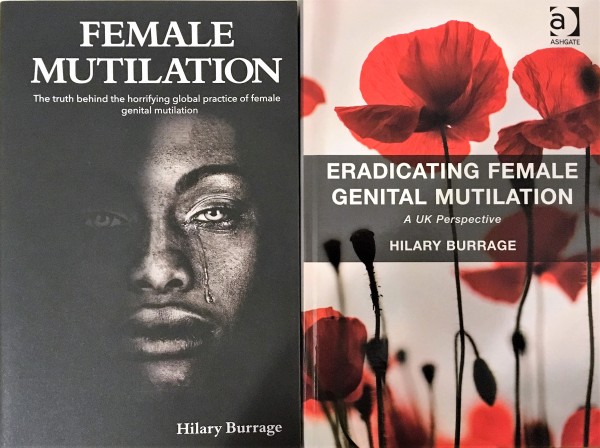
Hilary has published widely and has contributed two chapters to Routledge International Handbooks:
Female Genital Mutilation and Genital Surgeries: Chapter 33,
in Routledge International Handbook of Women’s Sexual and Reproductive Health (2019),
eds Jane M. Ussher, Joan C. Chrisler, Janette Perz
and
FGM Studies: Economics, Public Health, and Societal Well-Being: Chapter 12,
in The Routledge International Handbook on Harmful Cultural Practices (2023),
eds Maria Jaschok, U. H. Ruhina Jesmin, Tobe Levin von Gleichen, Comfort Momoh

 Hilary Burrage